Voltage in Table Saws: What It Is and Is It Worth It?
As an Amazon Associate we earn from qualifying purchases. Links on this page are affiliate links.
Understanding Voltage in Table Saws
Voltage is the electrical pressure that pushes current through your saw. It determines how much power the motor can deliver. When you see voltage explained on a listing, you are looking at the required power source. This spec is critical because it dictates which outlets you need and how the tool performs under load.
Most standard table saws operate on 120V. This is the standard household current in the United States. You can plug these tools into any standard wall outlet. They are ideal for hobbyists and light home use. The power is sufficient for cutting hardwoods and plywood in a typical garage workshop.
Professional-grade saws often require 230V. This higher voltage provides more consistent power for heavy-duty cutting. It reduces strain on the motor during demanding tasks. However, you cannot plug these into a standard outlet. You must have a dedicated circuit installed by a qualified electrician. This adds significant cost and complexity to your setup.
Cordless table saws use battery voltage to define their class. You will see options like 18V, 20V MAX, and 60V MAX. These numbers indicate the battery system, not the wall outlet. Higher voltage batteries generally offer more runtime and torque. An 18V system is portable but may struggle with thick hardwood. A 60V MAX system bridges the gap between corded and cordless performance.
Why does this matter to you? First, check your workspace. If you only have standard outlets, stick to 120V models. Second, consider your cutting needs. Heavy production work benefits from 230V stability. Portability favors the battery-powered options. Always match the voltage to your available power source. Mismatching can damage the tool or create safety hazards. Read the specifications carefully before purchasing.
Choosing the Right Voltage
120V
This is the standard household voltage in the US. You plug these tools into any regular wall outlet. It offers reliable power for most home workshops. The Makita JV0600K-R and Bosch JS365 use this spec. They are ideal for detailed cutting where cord access is easy. You do not need special wiring. However, you are limited by circuit capacity. Heavy cuts may trip breakers if the saw draws too much current. It is the safest choice for general DIYers. You get consistent performance without needing upgrades to your home electrical system. It suits users who prioritize convenience and standard outlet compatibility for their projects.
230V
This higher voltage provides more power with less current. You need a dedicated circuit and specific wiring. The JET JTAS-10XL50-1DX Table Saw uses this spec. It delivers serious power for wide, heavy-duty rip cuts. The 3 HP motor runs efficiently without overheating. This setup suits professional shops with ample space and electrical infrastructure. You gain cutting depth and speed that 120V tools cannot match. The trade-off is installation complexity and cost. You cannot simply plug it in anywhere. It is best for users who already have 230V outlets. It fits those who prioritize raw power and continuous duty cycles over portability.
20V MAX
This is a common cordless battery voltage. You use it for portability and ease of use. The DEWALT DCS334B Jig Saw operates on this system. It suits contractors who already own 20V batteries. You gain freedom from cords and noise. The tool is lightweight and easy to maneuver. However, runtime is limited by battery capacity. You may need spare batteries for all-day work. Power is sufficient for intricate cuts but not for heavy ripping. It is ideal for users who value convenience and existing battery ecosystems. You trade raw power for mobility. It works well for jobsites where outlets are scarce or inconvenient to reach.
18V
This voltage often pairs with dual-battery systems for higher output. The Makita XSR01Z Circular Saw uses two 18V batteries. This setup creates a 36V equivalent for high torque. It suits users needing professional-grade power without a cord. You get robust cutting performance for thick materials. The trade-off is added weight and bulk. You must carry two batteries or a single high-capacity pack. It is ideal for those with existing Makita 18V batteries. You gain versatility and runtime flexibility. It fits users who prioritize portability but still need significant cutting force. It is a strong choice for demanding tasks where corded power is not available.
60V MAX
This high voltage cordless system delivers near-corded power. The DEWALT DCS578B Circular Saw uses this spec. It offers deep cutting capacity and high speed. It suits users who prioritize voltage and cutting depth in a portable design. You get performance comparable to 120V tools. The trade-off is the cost of the battery system. You need 60V MAX batteries to operate it. It is ideal for contractors who already own this ecosystem. You gain professional results without a power cord. It fits users who need high power on jobsites. It is a premium option for those who value cordless convenience with maximum cutting capability.
Is Higher Voltage Worth It
Who needs it
You need higher voltage if you run heavy-duty tools daily. Industrial 230V models deliver consistent power under load. They handle dense hardwoods without slowing down. This spec matters for professional shops with dedicated circuits. You also need it if you use large blades frequently. The extra electrical pressure reduces strain on the motor. This extends the life of your equipment during long cuts. Cordless 20V MAX and 18V systems offer portability. They are ideal for job sites without reliable power. Choose these if you move tools often. High-voltage options are less critical for light weekend projects. Standard 120V outlets suffice for occasional use. Prioritize voltage if your work demands sustained performance. Check your workshop’s electrical capacity before upgrading. Ensure your wiring supports the higher amperage requirements. This ensures safety and optimal tool operation.
Who can skip it
Most home users can skip high-voltage upgrades. Standard 120V outlets handle typical DIY tasks well. You do not need 230V for occasional furniture builds. Focus on blade quality and fence accuracy instead. These features affect cut precision more than voltage. If you only use the saw on weekends, 120V is sufficient. It is easier to install and maintain. Avoid the complexity of dedicated circuits unless necessary. Prioritize safety features like blade guards and riving knives. These protect you during operation regardless of voltage. Consider portability if you work in small spaces. Compact 18V or 20V MAX tools offer flexibility. They do not require permanent installation. Save your time and effort for better blades. A sharp blade cuts cleaner than a powerful motor alone. Stick to standard voltage for most residential needs. It meets the demands of typical woodworking projects without extra cost or complexity.
Voltage Glossary Terms
Amperage
This measures the electrical current flow. Higher amps usually mean more power. You check this to ensure your circuit can handle the saw without tripping breakers.
Blade Diameter
This is the width of the cutting toothed circle. Common sizes are ten or twelve inches. A larger diameter allows deeper cuts through thick lumber.
Filtration Rating
This number shows how well the filter traps dust. Higher ratings capture finer particles. You want a high rating to keep your shop air clean.
Rip Capacity
This is the maximum width of wood you can cut. It measures from the blade to the fence. Check this spec to ensure it fits your largest projects.
Filter Type
This describes the material used to catch sawdust. Options include paper or cloth. The type affects how often you need to replace the filter.
Horsepower
This unit measures motor output strength. More horsepower helps cut dense hardwoods. You look for this spec to gauge cutting power under heavy loads.
Mounting Style
This tells you how the saw attaches to a surface. Options include benchtop or cabinet. Choose a style that fits your workspace and stability needs.
No-Load Speed
This is the blade rotation speed without cutting. Measured in revolutions per minute. Higher speeds often produce cleaner cuts in softer materials.
Quick picks
| # | Product | Best for | Price |
|---|---|---|---|
| 1 | Makita 6.5-Amp Top Handle Corded Jig Saw | Lightweight corded cutting in workshops | Check price of Makita 6.5-Amp Top Handle Corded Jig Saw on Amazon |
| 2 | JET 10-Inch XACTA Table Saw with 50-Inch Rip | Heavy-duty wide rip cutting | Check price of JET 10-Inch XACTA Table Saw with 50-Inch Rip on Amazon |
| 3 | DEWALT 20V MAX Cordless Brushless Jig Saw | portable cutting with existing 20V batteries | Check price of DEWALT 20V MAX Cordless Brushless Jig Saw on Amazon |
| 4 | Makita 18V X2 Brushless 7-1/4-Inch Rear Handle Saw | Users with existing Makita batteries needing high power | Check price of Makita 18V X2 Brushless 7-1/4-Inch Rear Handle Saw on Amazon |
| 5 | DEWALT 60V MAX 7-1/4-Inch Cordless Circular Saw | high voltage cordless cutting tasks | Check price of DEWALT 60V MAX 7-1/4-Inch Cordless Circular Saw on Amazon |
| 6 | Bosch 6.5-Amp Top-Handle Jigsaw | mixed-material cutting with variable speed control | Check price of Bosch 6.5-Amp Top-Handle Jigsaw on Amazon |
Our 6 picks

Makita 6.5-Amp Top Handle Corded Jig Saw
Best for: Lightweight corded cutting in workshops
- Voltage
- 120V (what this guide is about)
- Amperage
- 6.5 Amp
- Power Source
- Corded
- Dimensions
- 9.25 × 3.86 × 7.8 inches
View on Amazon: Makita 6.5-Amp Top Handle Corded Jig Saw Affiliate link
This Makita jig saw runs on 120V power with a 6.5 Amp motor. It features variable speed control from 500 to 3,100 SPM and three orbital settings. The tool weighs only 5.3 lbs and includes a counterbalance system to reduce vibration. It suits users who need a lightweight, corded saw for precise cuts in various materials.
Pros
- 6.5 Amp motor delivers consistent power
- Variable speed dial adjusts from 500 to 3,100 SPM
- Three orbital settings allow for faster or cleaner cuts
- Lightweight 5.3 lb design reduces operator fatigue
- Counterbalance system minimizes vibration during use
Cons
- Corded design limits mobility compared to battery tools
- 120V input may offer less power than 230V industrial models
- No brushless motor listed in specifications
Good fit if
- You prefer the reliability of a corded power source
- You need a lightweight tool for overhead or tight work
- You want variable speed control for different materials
Skip if
- You require cordless freedom for remote job sites
- You need high-amperage power for thick hardwoods
- You prefer a brushless motor for extended runtime
Verdict: Makita 120V 6.5 Amp Top Handle Jig Saw fits users who prioritize a lightweight, corded tool for detailed cutting tasks. It is ideal for workshop environments where power cords are accessible and vibration control is important.
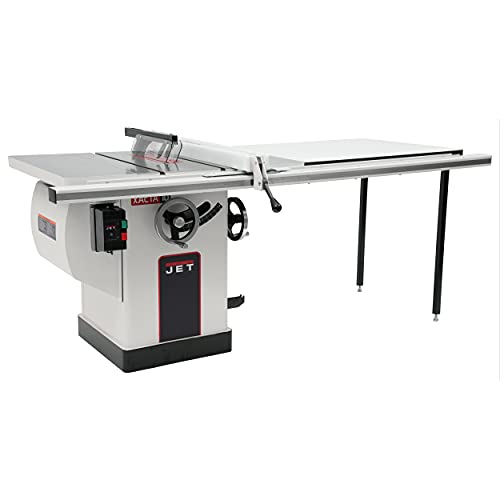
JET 10-Inch XACTA Table Saw with 50-Inch Rip
Best for: Heavy-duty wide rip cutting
- Voltage
- 230V (what this guide is about)
- Blade Diameter
- 10-Inch
- Rip Capacity
- 50-Inch
- Horsepower
- 3 HP
- Dimensions
- 85 × 36 × 38 inches
- Weight
- 510 pounds
View on Amazon: JET 10-Inch XACTA Table Saw with 50-Inch Rip Affiliate link
This JET table saw runs on 230V power with a 3 HP motor. It offers a 50-inch rip capacity and a 10-inch blade diameter. The heavy-duty build weighs 510 pounds. You need a dedicated workspace for this size. It suits users who require commercial-grade stability and wide material support for large projects.
Pros
- 230V 3 HP motor for high torque
- 50-inch rip capacity for wide stock
- 50-inch commercial XACTA fence system
- 11-inch cast iron extension wings
Cons
- Requires 230V electrical outlet
- 510-pound weight limits portability
- Large footprint needs dedicated space
Good fit if
- You have a 230V outlet available
- You cut wide lumber frequently
- You need a stationary shop setup
Skip if
- You only have 120V outlets
- You need to move the saw often
- You have limited floor space
Verdict: JET 10-Inch 3 HP 230V Table Saw delivers serious power for wide cuts. It fits workshops with 230V power and ample floor space.
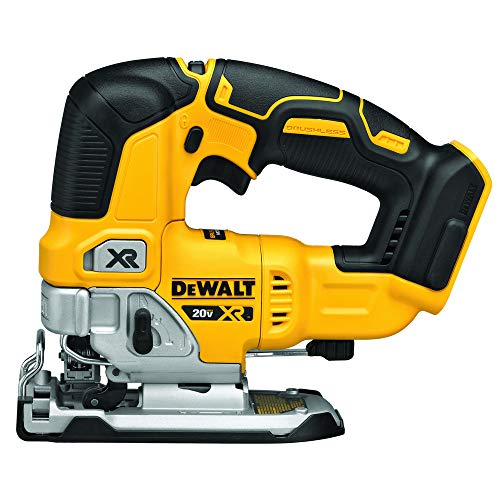
DEWALT 20V MAX Cordless Brushless Jig Saw
Best for: portable cutting with existing 20V batteries
- Voltage
- 20V MAX (what this guide is about)
- Power Source
- Cordless
- Dimensions
- 8.25 × 1.75 × 6.38 inches
- Weight
- 4.2 pounds
View on Amazon: DEWALT 20V MAX Cordless Brushless Jig Saw Affiliate link
This cordless jig saw runs on 20V MAX power. It features a brushless motor for efficient performance and longer runtime. The tool delivers up to 3,200 blade strokes per minute. You get variable speed control via a trigger and dial. An LED light illuminates your work surface. The all-metal shoe adjusts to four bevel angles. It weighs 4.2 pounds for manageable handling.
Pros
- Brushless motor delivers efficient performance
- Variable speed trigger and dial
- 4-position orbital action control
- Integrated dust blower
- Bright LED work light
Cons
- Bare tool only, no battery included
- Smaller capacity than 230V corded models
- Requires 20V MAX battery system
Good fit if
- You need cordless portability for jobsites
- You already own DEWALT 20V MAX batteries
- You want precise speed control for detailed cuts
Skip if
- You require a corded saw for continuous heavy duty use
- You do not own a compatible 20V MAX battery
- You prefer the raw power of 230V industrial tools
Verdict: DEWALT 20V MAX XR Brushless Jig Saw suits users who prioritize portability and runtime over raw power. It is ideal for contractors who already have the battery ecosystem and need a lightweight tool for intricate cuts.

Makita 18V X2 Brushless 7-1/4-Inch Rear Handle Saw
Best for: Users with existing Makita batteries needing high power
- Voltage
- 18V (what this guide is about)
- Blade Diameter
- 7-1/4"
- No-Load Speed
- 5,100 RPM
- Cutting Depth 90
- 2-9/16”
- Dimensions
- 18.8 × 8.9 × 12 inches
- Weight
- 12.1 pounds
View on Amazon: Makita 18V X2 Brushless 7-1/4-Inch Rear Handle Saw Affiliate link
This Makita circular saw uses two 18V batteries to deliver 36V power. It features a brushless motor that reaches 5,100 RPM for efficient cutting. The tool offers a 2-9/16-inch cutting depth at 90 degrees. It includes an electric brake and automatic speed change technology. You will appreciate the run time and torque adjustments for various materials.
Pros
- X2 LXT technology provides 36V power from two 18V batteries
- Brushless motor delivers 5,100 RPM for maximum performance
- Automatic Speed Change adjusts torque and speed during cuts
- Electric brake stops the blade quickly for safety
Cons
- Requires two separate batteries which are not included
- Heavier at 12.1 pounds compared to corded competitors
- No corded power option limits continuous runtime
Good fit if
- You need more power than standard 18V tools provide
- You want the flexibility of cordless operation
- You already own Makita 18V LXT batteries
Skip if
- You prefer the unlimited runtime of a corded saw
- You want a lighter tool for overhead work
- You do not want to manage multiple battery charges
Verdict: Makita 36V Brushless Circular Saw suits users who need high torque and runtime without a cord. It is ideal for those with existing Makita batteries who want professional-grade power.

DEWALT 60V MAX 7-1/4-Inch Cordless Circular Saw
Best for: high voltage cordless cutting tasks
- Voltage
- 60V MAX (what this guide is about)
- Blade Diameter
- 7-1/4-inch
- Cutting Depth 90
- 2-9/16-inch
- Dimensions
- 15.4 × 8.23 × 9.65 inches
- Weight
- 8.2 pounds
View on Amazon: DEWALT 60V MAX 7-1/4-Inch Cordless Circular Saw Affiliate link
This DEWALT circular saw runs on 60V MAX power, delivering up to 47% more power than its 20V MAX counterpart. It features a 7-1/4-inch blade with a 2-9/16-inch cut depth at 90 degrees. The tool weighs 8.2 pounds and includes an electric brake and LED light. It suits users who need high voltage performance in a cordless format.
Pros
- 60V MAX voltage platform for increased power
- 2-9/16-inch maximum cut depth at 90 degrees
- Electric brake stops the blade after trigger release
- Integrated LED for improved visibility
Cons
- Tool only; battery and charger not included
- Heavier build at 8.2 pounds
- No mention of dust collection port
Good fit if
- You require high voltage output from a cordless tool
- You need a 7-1/4-inch blade capacity
- You value electric brake safety features
Skip if
- You prefer 120V corded operation
- You need a lightweight tool under 7 pounds
- You want a complete kit with battery included
Verdict: DEWALT 60V MAX 7-1/4-Inch Circular Saw fits users who prioritize voltage and cutting depth in a portable, cordless design. It is ideal for those who already own 60V MAX batteries.
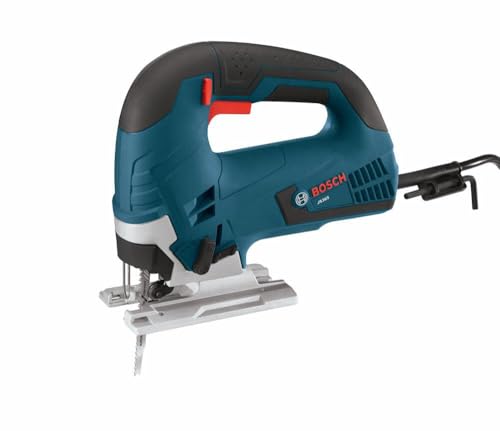
Bosch 6.5-Amp Top-Handle Jigsaw
Best for: mixed-material cutting with variable speed control
- Voltage
- 120V (what this guide is about)
- Amperage
- 6.5 Amp
- Dimensions
- 4 × 13 × 15 inches
- Weight
- 9 pounds
View on Amazon: Bosch 6.5-Amp Top-Handle Jigsaw Affiliate link
This Bosch jigsaw runs on standard 120V power with a 6.5 Amp motor. It features variable speed up to 3,000 SPM and four orbital settings for different materials. The top-handle design offers control, while tool-less blade changes save time. It suits users who need reliable corded performance for wood, aluminum, or steel cuts without voltage upgrades.
Pros
- 120V 6.5 Amp motor provides consistent power
- Variable speed dial allows precise control
- Tool-less blade-change system speeds up work
- Four orbital-action settings handle various materials
Cons
- Max speed of 3,000 SPM is lower than competitors
- Limited to 120V household outlets
- One-year warranty is shorter than industry standard
Good fit if
- You need a reliable corded tool for home workshops
- You prefer top-handle ergonomics for detailed cuts
- You work with wood, aluminum, or steel regularly
Skip if
- You require high-speed cutting above 3,000 SPM
- You need cordless freedom for job sites
- You want a longer warranty period
Verdict: Bosch JS365 120V 6.5 Amp Jigsaw fits DIYers who value control and versatility in a standard outlet tool. It is a solid choice for mixed-material projects where orbital settings matter more than raw speed.
Specifications side by side
| Spec | Makita 6.5-Amp Top Handle Corded Jig Saw | JET 10-Inch XACTA Table Saw with 50-Inch Rip | DEWALT 20V MAX Cordless Brushless Jig Saw | Makita 18V X2 Brushless 7-1/4-Inch Rear Handle Saw | DEWALT 60V MAX 7-1/4-Inch Cordless Circular Saw | Bosch 6.5-Amp Top-Handle Jigsaw |
|---|---|---|---|---|---|---|
| Blade Diameter | not stated | 10-Inch | not stated | 7-1/4" | 7-1/4-inch | not stated |
| Rip Capacity | not stated | 50-Inch | not stated | not stated | not stated | not stated |
| Amperage | 6.5 Amp | not stated | not stated | not stated | not stated | 6.5 Amp |
| Horsepower | not stated | 3 HP | not stated | not stated | not stated | not stated |
| No-Load Speed | not stated | not stated | not stated | 5,100 RPM | not stated | not stated |
| Cutting Depth 90 | not stated | not stated | not stated | 2-9/16” | 2-9/16-inch | not stated |
| Voltage | 120V | 230V | 20V MAX | 36V (18V X2) | 60V MAX* | 120V |
| Power Source | Corded | not stated | Cordless | not stated | not stated | not stated |
| Dimensions | 9.25 × 3.86 × 7.8 inches | 85 × 36 × 38 inches | 8.25 × 1.75 × 6.38 inches | 18.8 × 8.9 × 12 inches | 15.4 × 8.23 × 9.65 inches | 4 × 13 × 15 inches |
| Weight | not stated | 510 pounds | 4.2 pounds | 12.1 pounds | 8.2 pounds | 9 pounds |
| Color | White | White | Yellow | Teal | Multi | Blue |
| Model | JV0600K-R | JTAS-10XL50-1DX | DCS334B | XSR01Z | DCS578B | JS365 |
| Size | not stated | 10-Inch | One Size | No Size | One Size | 6.5 Amp |
Frequently asked questions
Can I use a 230V table saw in a standard home garage?
No, you cannot. A 230V tool requires a dedicated industrial circuit. Standard US homes only provide 120V outlets. You would need professional electrical installation to power machines like the JET JTAS-10XL50-1DX. This saw weighs 510 pounds and needs serious infrastructure. It is not suitable for typical residential wiring.
What is the difference between 18V and 20V MAX battery tools?
The numbers refer to marketing voltage, not actual output. Both systems use similar battery cell configurations. Brands like Makita and DEWALT use these ratings for their cordless ecosystems. The 18V Makita XSR01Z and 20V DEWALT DCS334B offer comparable runtime. You should choose based on existing battery compatibility rather than the voltage number.
Does higher voltage mean a faster cutting speed?
Not necessarily. Voltage indicates power potential, not rotational speed. A 120V Bosch JS365 offers variable speed control for precision. A 60V MAX DEWALT DCS578B provides torque for depth. Speed depends on the motor design and settings. Higher voltage allows the motor to maintain speed under heavy load without stalling.
Is a 60V MAX cordless saw as powerful as a corded one?
It approaches corded performance in many tasks. The DEWALT DCS578B uses 60V MAX batteries to deliver high torque. It cuts 7-1/4-Inch blades with significant depth. However, runtime depends on battery capacity. You must manage charge levels during long jobs. It offers portability without sacrificing much cutting power.
Why do some table saws require 230V instead of 120V?
Higher voltage reduces current draw for the same power output. A 3 HP saw like the JET model needs 230V to operate safely. Lower voltage would require thicker wires and larger breakers. It prevents overheating in the motor during continuous use. This spec is essential for heavy-duty ripping and dense hardwoods.
Can I run a 120V jig saw on a standard outlet?
Yes, you can. Tools like the Makita JV0600K-R and Bosch JS365 use 120V. They plug directly into any standard US wall socket. This makes them ideal for home workshops. You do not need special electrical work. These tools provide reliable power for detailed cuts and mixed-material projects.