120V vs 20V MAX Table Saws: Which Should You Buy?
As an Amazon Associate we earn from qualifying purchases. Links on this page are affiliate links.
Choosing between a 120V vs 20V MAX table saw involves understanding power sources. Both tools deliver precision cutting for various materials. The main difference lies in their voltage and power delivery. One uses a standard corded plug, while the other relies on a battery pack. This guide compares their specs to help you decide which fits your workflow.
Key differences
| Aspect | Makita 6.5-Amp Top Handle Corded Jig Saw | DEWALT 20V MAX Cordless Brushless Jig Saw |
|---|---|---|
| Voltage | 120V | 20V MAX |
| Amperage | 6.5 Amp | not listed |
| Power Source | Corded | Cordless |
| Weight | 5.3 lbs | 4.2 lbs |
| Motor Type | not listed | Brushless |
Which one should you choose?
Choose Makita 6.5-Amp Top Handle Corded Jig Saw if
- You need continuous power without worrying about battery life.
- You prefer a heavier tool that may reduce vibration during use.
- You work in a shop with easy access to standard outlets.
Choose DEWALT 20V MAX Cordless Brushless Jig Saw if
- You want a lighter tool for easier handling in tight spaces.
- You need cordless freedom to move around the job site.
- You prefer a brushless motor for longer runtime and efficiency.
Verdict: The 120V option suits users who need constant power and do not mind being tethered to an outlet. The 20V MAX model is better for those who prioritize portability and a lighter weight. Your choice depends on whether you value corded reliability or cordless flexibility.
120V vs 20V MAX Jig Saw
Power source type
The Makita model relies on a 120V corded connection, ensuring consistent power without battery depletion. You plug it directly into a standard outlet, which eliminates runtime anxiety during long projects. In contrast, the DEWALT tool operates on a 20V MAX cordless system. This offers mobility and eliminates cord clutter, but requires managing battery charge levels. The choice depends on whether you prioritize uninterrupted continuous operation or flexible positioning away from outlets.
Motor amperage
The Makita jig saw features a 6.5 Amp motor, a specification that indicates strong torque and cutting capability for dense materials. This high amperage supports its variable speed control from 500 to 3,100 SPM. The DEWALT unit lists a brushless motor but does not provide an amperage rating in the data. Brushless motors generally offer efficiency, but without the specific amp draw, you cannot directly compare the raw power output between these two distinct models based solely on published specifications.
Blade speed range
Speed control is critical for different materials. The Makita provides a variable speed dial ranging from 500 to 3,100 strokes per minute. This allows you to match the speed precisely to the application, from delicate veneers to tough metals. The DEWALT jig saw reaches a maximum of 3,200 blade speed. While the Makita offers a defined lower bound, the DEWALT reaches a slightly higher peak. Both tools allow variable control, but the specific ranges differ slightly in their maximum capabilities.
Tool weight
Operator fatigue is reduced by lighter tools. The Makita jig saw weighs 5.3 pounds, which is described as well-balanced for reduced fatigue. The DEWALT model is lighter at 4.2 pounds. This difference of 1.1 pounds may be noticeable during overhead work or extended use. The DEWALT’s compact size and lower weight contribute to maximum control and ease of handling. If you are cutting for long periods, the lighter DEWALT may feel less taxing on your arm.
Dust management
Keeping your work area clean is easier with effective dust extraction. The Makita includes a through-the-body dust port designed for use with a vacuum, providing efficient dust management by removing debris at the source. The DEWALT tool features an integrated dust blower that clears the line of sight. This method pushes air away rather than collecting dust. The Makita’s vacuum port is superior for containment, while the DEWALT’s blower helps you see the cut line better during operation.
Which jigsaw fits your workflow best
Users needing constant power for long jobs
The Makita 6.5-Amp motor draws from a standard 120V outlet. This corded design ensures consistent power delivery without runtime limits. You avoid the anxiety of battery depletion during extended use. The tool delivers faster cuts through three orbital settings and variable speed control ranging from 500 to 3,100 SPM. This makes it ideal for workshop environments where a power cord is always accessible.
Professionals requiring portability and brushless efficiency
The DEWALT 20V MAX XR model features a brushless motor for efficient performance and longer runtime. Its cordless design offers maximum control and easy grip in compact areas. The tool weighs only 4.2 pounds, reducing operator fatigue. An integrated dust blower clears the line of sight, while an LED light illuminates dim work surfaces. This setup suits job sites where mobility is essential.
DIyers valuing quick blade changes and balance
The Makita jig saw includes a tool-less blade change system for fast installation and removal. Its well-balanced design weighs just 5.3 lbs to reduce fatigue. A counterbalance system minimizes vibration for smoother operation. The through-the-body dust port connects to a vacuum for efficient management. These features support accurate cuts in various materials without the need for separate batteries or charging stations.
Quick picks
| # | Product | Best for | Price |
|---|---|---|---|
| 1 | Makita 6.5-Amp Top Handle Corded Jig Saw | Users needing reliable 120V corded power | Check price of Makita 6.5-Amp Top Handle Corded Jig Saw on Amazon |
| 2 | DEWALT 20V MAX Cordless Brushless Jig Saw | portable, precise detail cutting | Check price of DEWALT 20V MAX Cordless Brushless Jig Saw on Amazon |
The products compared

Makita 6.5-Amp Top Handle Corded Jig Saw
Best for: Users needing reliable 120V corded power
- Voltage
- 120V (what this guide is about)
- Amperage
- 6.5 Amp
- Power Source
- Corded
- Dimensions
- 9.25 × 3.86 × 7.8 inches
View on Amazon: Makita 6.5-Amp Top Handle Corded Jig Saw Affiliate link
This Makita jig saw uses a 120V corded 6.5 Amp motor for consistent power. It features variable speed control from 500 to 3,100 SPM and three orbital settings for faster, more accurate cuts. The top handle design and 5.3 lb weight reduce fatigue. It includes a through-the-body dust port and a tool-less blade change system. This tool suits users who need reliable corded performance in compact spaces.
Pros
- 120V 6.5 Amp motor delivers steady power
- Variable speed dial adjusts from 500 to 3,100 SPM
- Three orbital settings optimize cut speed and finish
- Tool-less blade change system allows quick swaps
- Through-the-body dust port connects to a vacuum
Cons
- Corded design restricts mobility compared to battery tools
- Top handle limits visibility for some users
- No brushless motor technology listed
Good fit if
- You prefer the consistent power of a 120V corded tool
- You need variable speed control for different materials
- You work in tight spaces where a top handle helps
Skip if
- You require a cordless 20V MAX tool for portability
- You need a brushless motor for extended runtime
- You prefer a side-handle design for better visibility
Verdict: Makita 120V 6.5 Amp Top Handle Jig Saw offers reliable corded performance for users who prioritize steady power and variable speed control over cordless mobility.
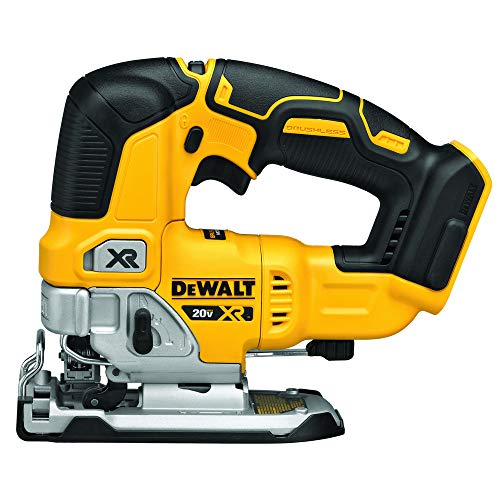
DEWALT 20V MAX Cordless Brushless Jig Saw
Best for: portable, precise detail cutting
- Voltage
- 20V MAX (what this guide is about)
- Power Source
- Cordless
- Dimensions
- 8.25 × 1.75 × 6.38 inches
- Weight
- 4.2 pounds
View on Amazon: DEWALT 20V MAX Cordless Brushless Jig Saw Affiliate link
This DEWALT tool uses a 20V MAX battery to power a brushless motor. It reaches 3,200 blade strokes per minute for efficient cutting. The compact design weighs 4.2 pounds and measures 8.25 inches long. An LED light illuminates your work area. You get variable speed control and a 4-position orbital action dial. This bare tool requires a separate battery and charger.
Pros
- Brushless motor delivers efficient performance and longer runtime
- Variable speed trigger and dial allow precise control
- 4-position orbital action adjusts cut quality and speed
- Integrated dust blower clears the line of sight
- All-metal keyless shoe bevel adjusts to 0, 15, 30, and 45 degrees
Cons
- Sold as a bare tool without battery or charger
- No corded power option for continuous use
- Limited to 20V MAX battery capacity
Good fit if
- You need cordless freedom for tight spaces
- You want precise speed control for detailed cuts
- You already own DEWALT 20V MAX batteries
Skip if
- You require a corded saw for unlimited runtime
- You need a complete kit with battery included
- You prefer a heavier, more stable base
Verdict: DEWALT 20V MAX XR Cordless Jig Saw suits users who prioritize portability and precise control in a compact package. It is ideal for those who already have compatible batteries and need a lightweight tool for detailed work.
Specifications side by side
| Spec | Makita 6.5-Amp Top Handle Corded Jig Saw | DEWALT 20V MAX Cordless Brushless Jig Saw |
|---|---|---|
| Amperage | 6.5 Amp | not stated |
| Voltage | 120V | 20V MAX |
| Power Source | Corded | Cordless |
| Dimensions | 9.25 × 3.86 × 7.8 inches | 8.25 × 1.75 × 6.38 inches |
| Weight | not stated | 4.2 pounds |
| Color | White | Yellow |
| Model | JV0600K-R | DCS334B |
| Size | not stated | One Size |
Frequently asked questions
Is a 120V tool better than a 20V MAX for long jobs?
Yes, for extended use, a 120V corded tool is superior. The Makita 120V model provides consistent power without runtime limits. You do not need to worry about battery depletion during long projects. This makes it ideal for users who prioritize steady performance over portability.
Can I use a 20V MAX saw for portable work?
Yes, the 20V MAX option is designed for portability. The DEWALT 20V MAX brushless model weighs only 4.2 pounds. Its compact size and cordless design make it easy to carry. This is best for detailed work where mobility is more important than continuous power.
Which voltage is better for precision detail cutting?
The 20V MAX tool is often better for precision. The DEWALT 20V MAX XR model offers precise control in a compact package. Its lightweight design allows for better handling during intricate cuts. If you need maneuverability, this voltage class is the practical choice.
Do I need batteries for a 120V jigsaw?
No, you do not need batteries for a 120V tool. The Makita model plugs directly into a standard outlet. This eliminates the need to charge or swap batteries. It ensures you always have power available as long as you are near an electrical outlet.
What is the weight difference between these two options?
The 20V MAX tool is significantly lighter. The DEWALT model weighs 4.2 pounds, making it easy to handle for long periods. The 120V Makita tool is heavier due to its corded motor and housing. If weight is a concern, the cordless option is lighter.
Is the 20V MAX model brushless?
Yes, the DEWALT 20V MAX model features a brushless motor. This design often provides longer runtime and increased durability. It suits users who want efficient power delivery in a cordless format. The brushless technology is a key feature for this specific 20V MAX tool.
Which tool is better for users who already have batteries?
If you already own compatible batteries, the 20V MAX tool is a strong choice. The DEWALT model integrates seamlessly with existing battery systems. This allows you to use tools you already own. It is ideal for those who value versatility and do not want to buy a separate power source.