Makita vs VEVOR Table Saws: Which Brand Fits You?
As an Amazon Associate we earn from qualifying purchases. Links on this page are affiliate links.
This makita vs VEVOR table saw comparison highlights two distinct tools. Both are power saws designed for cutting materials, but they serve different purposes. The Makita is a jig saw built for curved and intricate cuts. The VEVOR is a sliding compound miter saw made for precise crosscuts and angles. You need to choose based on the type of cuts you perform most often.
Key differences
| Aspect | Makita 6.5-Amp Top Handle Corded Jig Saw | VEVOR 10-Inch Dual Bevel Sliding Miter Saw |
|---|---|---|
| Blade Diameter | not listed | 10 inches |
| Amperage | 6.5 Amp | 15 Amp |
| No-Load Speed | not listed | 5000 RPM |
| Cutting Style | Jig saw | Sliding compound miter |
Which one should you choose?
Choose Makita 6.5-Amp Top Handle Corded Jig Saw if
- You need to cut curves or intricate shapes in wood.
- You prefer a lighter tool for handling in compact areas.
- You require variable speed control for different materials.
Choose VEVOR 10-Inch Dual Bevel Sliding Miter Saw if
- You make frequent crosscuts or angled miter cuts.
- You need to cut wider boards using a sliding mechanism.
- You want high power for cutting hardwoods quickly.
Verdict: Choose the Makita if your work involves detailed, curved, or irregular cuts. Pick the VEVOR if you need a heavy-duty saw for straight, precise, and wide crosscuts. Your choice depends entirely on whether you prioritize intricate shaping or structural cutting.
Makita vs VEVOR: Key Specs Compared
Power and speed
The VEVOR 10-Inch Dual Bevel Sliding Miter Saw offers significantly more raw power than the Makita tool. It features a 15 Amp motor that delivers up to 5000 RPM, enabling it to cut through hardwoods and large timber builds with ease. In contrast, the Makita 6.5-Amp Top Handle Corded Jig Saw is designed for precision rather than brute force. Its variable speed control ranges from 500 to 3,100 SPM, allowing you to match the speed to specific materials like metal or plastic. While the Makita provides finer control for intricate work, the VEVOR’s higher amperage and RPM make it better for heavy-duty crosscuts.
Blade diameter
The VEVOR saw comes equipped with a 10-inch blade, which allows for wider crosscuts and the ability to handle larger pieces of lumber without multiple passes. This is ideal for framing or building large furniture projects where width matters. The Makita jig saw does not list a specific blade diameter in its specifications, as jig saw blades are typically smaller and interchangeable depending on the cut required. This difference highlights the distinct purposes of each tool: the VEVOR is built for structural cuts, while the Makita is optimized for detailed, curved, or internal cuts where a large blade would be impractical.
Weight and portability
Portability differs greatly between these two tools due to their intended use. The Makita jig saw is exceptionally lightweight at only 5.3 lbs, making it easy to hold for extended periods and reduce operator fatigue during detailed work. Its low profile design also aids handling in compact areas. The VEVOR miter saw weighs 39.7 pounds, reflecting its sturdy aluminum base and sliding mechanism. While heavier, this weight provides stability during powerful cuts. You would likely keep the VEVOR on a workbench or mount it to a wall, whereas the Makita is designed to be moved around the workshop for specific tasks.
Cutting capabilities
These tools offer completely different cutting functions. The VEVOR is a sliding compound miter saw, capable of dual bevel cuts and axial sliding for wider crosscuts. It includes an LED guide and precision scales for accurate angled cuts, making it suitable for frames and complex assemblies. The Makita is a jig saw, engineered for curved cuts, intricate shapes, and cutting through various materials using orbital settings. It features a through-the-body dust port for vacuum attachment and a tool-less blade change system. If you need straight, wide cuts, the VEVOR wins; for curves, the Makita is the only option.
Build and durability
Both tools emphasize durability in their construction. The Makita features a die-cast aluminum housing base, which adds strength while keeping the unit light. It also includes a counterbalance system to reduce vibration, ensuring smoother operation during delicate cuts. The VEVOR utilizes an upgraded aluminum base that is lighter than traditional cast iron but still optimized for strength and heat dissipation during intensive industrial workloads. Its sturdy locking hardware ensures angles remain fixed during use. Both brands prioritize robust materials, though the Makita focuses on vibration control while the VEVOR focuses on structural stability for heavy cutting.
Which saw fits your specific needs
You need intricate curved cuts
The Makita jig saw is built for detailed work. Its top handle and low profile design improve handling in tight spaces. The 6.5-amp motor with variable speed control from 500 to 3,100 SPM lets you match speed to material. The counterbalance system reduces vibration for accuracy. It weighs only 5.3 lbs, reducing fatigue during long projects requiring precise, non-linear cuts.
You make wide crosscuts and frames
The VEVOR miter saw excels at wide cuts and angled joints. Its axial sliding system allows smooth forward-and-back movement for larger lumber. Dual bevel capability handles bi-directional cuts for complex assemblies. The 15-amp motor runs at 5000 RPM, cutting hardwoods effortlessly. An LED guide projects crisp lines, while precision scales remove guesswork. The 10-inch blade diameter accommodates substantial stock for furniture builds.
You want a lightweight portable tool
Portability matters if you move tools often. The Makita weighs just 5.3 lbs, making it easy to carry. Its compact dimensions of 9.25 by 3.86 by 7.8 inches fit small bags. The tool-less blade change system speeds up setup. The through-the-body dust port connects to a vacuum for cleanup. This corded 120V tool offers durability with a die-cast aluminum base without the bulk of heavier stationary equipment.
The products compared
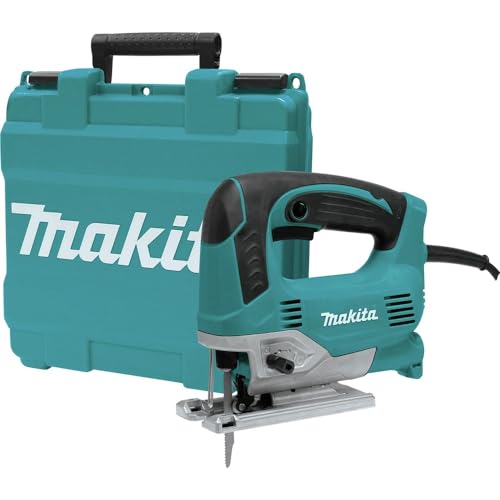
Makita 6.5-Amp Top Handle Corded Jig Saw
Best for: Detailed cuts in compact spaces
- Amperage
- 6.5 Amp
- Voltage
- 120V
- Power Source
- Corded
- Dimensions
- 9.25 × 3.86 × 7.8 inches
View on Amazon: Makita 6.5-Amp Top Handle Corded Jig Saw Affiliate link
This Makita jig saw features a 6.5 Amp motor and variable speed control from 500 to 3,100 SPM. The tool-less blade change system and through-the-body dust port add convenience. Weighing only 5.3 lbs with a low profile, it offers reduced vibration and fatigue. It suits users needing accurate cuts in compact areas with efficient dust management.
Pros
- 6.5 Amp motor for faster cutting
- Variable speed control (500 - 3,100 SPM)
- Tool-less blade change system
- Through-the-body dust port
- Lightweight 5.3 lbs design
Cons
- Corded power limits mobility
- No orbital setting adjustment listed
- Includes only a tool case, not a stand
Good fit if
- You need precise cuts in tight spaces
- You prefer corded power for consistent performance
- You want to connect a vacuum for dust control
Skip if
- You require a battery-powered tool
- You need a large table saw for sheet goods
- You want a portable band saw
Verdict: Makita 6.5 Amp Jig Saw is a practical choice for detailed work in confined areas. It fits users who value lightweight handling and dust extraction over cordless freedom.

VEVOR 10-Inch Dual Bevel Sliding Miter Saw
Best for: Detailed framing and precise angled cuts
- Blade Diameter
- 10"
- Amperage
- 15 Amp
- No-Load Speed
- 5000 RPM
- Dimensions
- 30.3 × 20.9 × 27.6 inches
- Weight
- 39.7 pounds
View on Amazon: VEVOR 10-Inch Dual Bevel Sliding Miter Saw Affiliate link
This VEVOR miter saw features a 10-inch blade and a 15-amp motor running at 5000 RPM. The axial sliding system allows for wider crosscuts, while dual bevel capability supports detailed framing. An upgraded aluminum base keeps the 39.7-pound unit mobile. It includes an LED guide and precision scales for accurate angle adjustments. This tool suits woodworkers needing precise angled cuts for furniture or timber builds.
Pros
- 15-amp motor delivers 5000 RPM for cutting hardwoods
- Axial sliding system enables wider crosscuts
- Dual bevel cuts for complex joint assemblies
- LED guide projects crisp cut lines
- Upgraded aluminum base reduces weight for mobility
Cons
- 10-inch blade limits cutting width compared to 12-inch models
- Corded design restricts portable use
- No mention of included blade tooth count in key specs
Good fit if
- You need precise dual bevel cuts for custom frames
- You want a lighter saw for easier workshop mobility
- You require a sliding mechanism for wider lumber
Skip if
- You need a cordless tool for remote sites
- You require a 12-inch blade for maximum capacity
- You prefer a cast iron base for vibration dampening
Verdict: VEVOR 10" Sliding Compound Miter Saw offers solid sliding capacity and dual bevel precision for detailed woodworking. It fits users who prioritize mobility and accurate angled cuts over maximum blade size.
Specifications side by side
| Spec | Makita 6.5-Amp Top Handle Corded Jig Saw | VEVOR 10-Inch Dual Bevel Sliding Miter Saw |
|---|---|---|
| Blade Diameter | not stated | 10" |
| Amperage | 6.5 Amp | 15 Amp |
| No-Load Speed | not stated | 5000 RPM |
| Voltage | 120V | not stated |
| Power Source | Corded | not stated |
| Dimensions | 9.25 × 3.86 × 7.8 inches | 30.3 × 20.9 × 27.6 inches |
| Weight | not stated | 39.7 pounds |
| Color | White | Black |
| Model | JV0600K-R | J1G-ZP33-K255D |
| Size | not stated | 10 in |
Frequently asked questions
Is the Makita tool a table saw?
No, the Makita model listed is a jig saw, not a table saw. It is designed for detailed cuts in compact spaces. You can use it for intricate work where a larger saw cannot fit. The VEVOR option is a sliding miter saw, which also differs from a standard table saw layout.
What is the main difference between these two saws?
The primary difference is their cutting function and motor power. The Makita is a 6.5-amp jig saw for curved or detailed cuts. The VEVOR is a 15-amp sliding miter saw built for precise angled cuts and framing. One handles curves, while the other handles straight, beveled cuts with sliding capacity.
Does the Makita saw have a cord?
Yes, the Makita tool is corded. It requires a 120V power source to operate. This design ensures consistent power delivery without battery changes. You must keep it near an outlet during use, which supports its role in detailed work where steady performance is critical.
How heavy is the VEVOR saw?
The VEVOR sliding miter saw weighs 39.7 pounds. This weight contributes to its stability during heavy cuts. Its dimensions are 20.9 inches wide, 27.6 inches high, and 30.3 inches long. You should ensure your workspace can accommodate this footprint and weight for safe operation.
Can the VEVOR saw cut bevels?
Yes, the VEVOR model features dual bevel capabilities. This allows you to make precise angled cuts without flipping the material. It is a 10-inch blade saw with a sliding compound design. This feature is ideal for detailed framing work where accuracy and speed are important.
Which tool is better for tight spaces?
The Makita jig saw is better for tight spaces. Its compact size measures 3.86 inches wide and 7.8 inches high. The top handle design improves handling in confined areas. You can maneuver it easily where larger saws like the VEVOR miter saw cannot fit.
What is the blade size of the VEVOR saw?
The VEVOR saw uses a 10-inch blade diameter. This size provides a good balance between cutting capacity and control. It is part of a sliding compound miter saw design. You can use this blade for various materials, including hardwoods, due to its 15-amp motor power.