Horsepower in Table Saws: What It Is and Is It Worth It?
As an Amazon Associate we earn from qualifying purchases. Links on this page are affiliate links.
Understanding Horsepower in Table Saws
Horsepower is the standard unit for measuring the power output of a table saw motor. It tells you how much work the machine can do over time. When you see this spec on a listing, it indicates the motor's capacity to handle resistance. Higher numbers generally mean more raw power available for cutting.
In the table saw niche, you will typically see two main ratings. The first is 1.75 HP. This is common in contractor and portable models. It provides enough torque for general woodworking tasks. You can cut standard lumber and sheet goods without issue. However, you may need to feed the material slower when cutting dense hardwoods. The motor might bog down under heavy loads.
The second rating is 3 HP. This is found in cabinet saws and high-end hybrid models. This motor delivers significantly more torque. It maintains speed even when pushing thick or hard material. You can take deeper cuts and use wider blades without straining the engine. The saw stays stable during demanding operations.
Buyers care about this spec because it affects performance. If you plan to cut thick oak or maple regularly, a 3 HP motor is a better choice. It reduces the risk of stalling and burn marks on your wood. For occasional use or softwoods, 1.75 HP is sufficient. It is lighter and often more affordable.
When reading listings, check if the rating is peak or continuous. Peak horsepower is the maximum burst of power. Continuous horsepower is what the motor can sustain. Manufacturers often list the higher peak number. Understanding this helps you set realistic expectations. Always match the motor power to your typical project size. This ensures your saw lasts longer and performs reliably. Knowing what horsepower explained means helps you choose the right tool for your workshop needs.
Horsepower options compared
1.75 HP
This rating suits workshops with limited electrical capacity. It runs on standard 120V outlets, making it accessible for most garages. The motor provides enough torque for general ripping and crosscutting. You get a reliable tool without needing specialized wiring. However, you may notice slower feed rates in dense hardwoods. The JET ProShop II 10-Inch Table Saw with Cast Wings uses this motor. It offers a 30-inch rip capacity while staying compatible with home circuits. This setup balances power and convenience for hobbyists or light professional use.
3 HP
This level delivers serious torque for heavy-duty work. It typically requires 230V power, which is common in dedicated shops. The extra power helps maintain blade speed under load, allowing faster cuts through thick or hard materials. You gain stability and efficiency when processing large volumes of stock. The trade-off is the need for higher voltage infrastructure. The SawStop Professional 3 HP Cabinet Saw with 52-Inch Rip exemplifies this class. It pairs high power with a massive 52-inch rip capacity. This combination fits serious woodworkers who prioritize speed and safety in a professional environment.
Is Horsepower Worth The Upgrade
Who needs it
You should prioritize higher horsepower if you regularly cut dense hardwoods like oak, maple, or walnut. The 3 HP motor delivers the sustained torque needed to push thick stock through the blade without bogging down. This capacity ensures clean cuts even when feeding material at a steady pace. If you run a small shop or perform frequent rip cuts on wide panels, the extra power prevents stalling and reduces strain on the motor. It also handles thicker materials more efficiently, saving you time and effort. For professionals or serious hobbyists who demand consistent performance under heavy loads, this spec is essential. It allows for uninterrupted workflow and maintains blade speed during demanding tasks. If your projects involve large-scale construction or frequent heavy-duty cutting, investing in this power level pays off in reliability and results. The 1.75 HP option may struggle under these conditions, leading to uneven cuts or motor overheating.
Who can skip it
You can ignore the higher horsepower rating if your work primarily involves softwoods, plywood, or sheet goods. The 1.75 HP motor provides ample power for general woodworking tasks and standard crosscutting. It runs on standard 120V outlets, making it accessible for most home workshops without requiring specialized electrical upgrades. If you are a casual DIYer or work in a space with limited electrical capacity, this lower spec is sufficient. Prioritize blade quality and fence accuracy over raw power for these applications. The extra cost and energy consumption of a 3 HP unit offer no practical benefit for light-duty tasks. Focus on finding a saw with a stable table and precise alignment instead. The 1.75 HP model offers reliable performance for occasional use. It is easier on your budget and electrical system. You will not notice a difference in cut quality for thin materials. Stick with the lower spec unless you face specific heavy-load challenges.
Table Saw Glossary Terms
Horsepower
A measure of motor power output. Higher ratings like 1.75 HP suit light tasks, while 3 HP handles dense hardwoods without slowing down during heavy cuts.
Amperage
The electrical current the motor draws. Higher amps often indicate a more powerful motor. Standard 120V outlets typically support lower amp ratings for garage use.
Blade Diameter
The size of the cutting wheel. Common sizes are 10 inches. Larger blades allow for deeper cutting depths, which is useful for thick lumber projects.
Rip Capacity
The maximum width of material the saw can cut. This distance is measured from the blade to the fence. Larger capacities handle wide sheets of plywood.
No-Load Speed
How fast the blade spins when not cutting. Measured in RPMs, typical values range from 3,000 to 5,000. Higher speeds often provide cleaner cuts in thin materials.
Mounting Style
How the saw attaches to a surface. Options include cabinet, contractor, or benchtop. This determines stability and portability based on your workshop layout.
Filtration Rating
A measure of dust collection efficiency. Higher ratings capture more fine particles. This spec helps keep your workspace cleaner and improves air quality while cutting.
Filter Type
The specific material used in the dust bag or cyclone. Common types include cloth or mesh. The type affects how well the system blocks fine sawdust.
Quick picks
Our 6 picks

JET ProShop II 10-Inch Table Saw with Cast Wings
Best for: 120V workshops needing 30-inch rip capacity
- Horsepower
- 1.75 HP (what this guide is about)
- Blade Diameter
- 10-Inch
- Rip Capacity
- 30-Inch
- Voltage
- 120V
- Dimensions
- 60 × 40 × 43 inches
View on Amazon: JET ProShop II 10-Inch Table Saw with Cast Wings Affiliate link
The JET ProShop II is a 10-inch table saw with 1-3/4 HP motor power. It offers a 30-inch rip capacity on 120V power. This model features cast wings and a magnetic paddle switch for safety. It suits users who need moderate cutting width and reliable single-phase power for standard workshop tasks.
Pros
- 1-3/4 HP motor provides solid cutting power
- 30-inch rip capacity handles wide boards
- Magnetic paddle switch enhances operational safety
- Quick-release riving knife simplifies blade changes
Cons
- 30-inch rip capacity is smaller than competitors
- 120V power limits heavy-duty industrial use
- Cast wings may be less rigid than steel alternatives
Good fit if
- You need a 120V saw for standard workshops
- You require a 30-inch rip capacity for most projects
- You prefer magnetic paddle switch safety features
Skip if
- You require more than 30-inch rip capacity
- You need 3 HP motor power for heavy cuts
- You only work with 230V electrical systems
Verdict: JET ProShop II 10-Inch Table Saw fits users who prioritize safety and moderate capacity. It is ideal for shops using 120V power and needing 30-inch rip space.
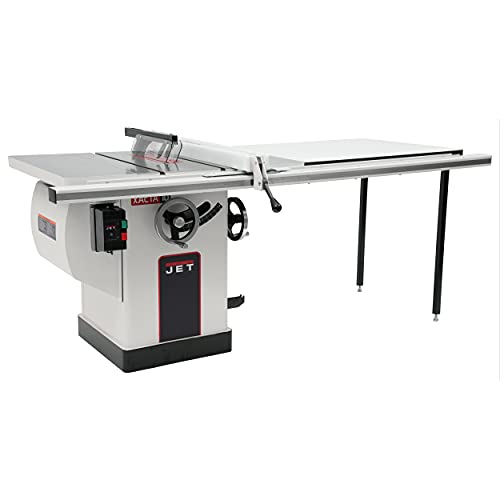
JET 10-Inch XACTA Table Saw with 50-Inch Rip
Best for: 230V shops needing 50-inch rip capacity
- Horsepower
- 3 HP (what this guide is about)
- Blade Diameter
- 10-Inch
- Rip Capacity
- 50-Inch
- Voltage
- 230V
- Dimensions
- 85 × 36 × 38 inches
- Weight
- 510 pounds
View on Amazon: JET 10-Inch XACTA Table Saw with 50-Inch Rip Affiliate link
The JET 10-Inch Deluxe XACTA is a 3 HP cabinet saw designed for heavy-duty use. It features a 230V motor and a 50-inch rip capacity, supported by a 510-pound frame. The wide-stance trunnion and cast iron wings provide stability. This machine suits users who need maximum rip space and quiet operation via its Poly-V drive belt system.
Pros
- 3 HP motor for high power
- 50-inch rip capacity
- 230V single-phase voltage
- 510-pound weight for stability
- 11-inch cast iron extension wings
Cons
- Requires 230V power outlet
- 510-pound weight is very heavy
- No 120V adapter option listed
Good fit if
- You need a 50-inch rip capacity
- You have a 230V electrical supply
- You want a heavy, stable cabinet saw
Skip if
- You only have 120V outlets
- You need a portable saw under 200 pounds
- You require a rip capacity over 50 inches
Verdict: JET 10-Inch Deluxe XACTA 3 HP delivers serious power and a massive 50-inch rip capacity for shop-based work. It fits users with 230V power who prioritize stability and large material handling.

JET ProShop II 10-Inch Table Saw with 52-Inch Rip
Best for: High-capacity cuts on 120V circuits
- Horsepower
- 1.75 HP (what this guide is about)
- Blade Diameter
- 10-Inch
- Rip Capacity
- 52-Inch
- Voltage
- 120V
- Dimensions
- 82 × 40 × 43 inches
- Weight
- 286 pounds
View on Amazon: JET ProShop II 10-Inch Table Saw with 52-Inch Rip Affiliate link
The Jet JPS-10 delivers 1.75 HP of power on a 120V circuit. It offers a 52-inch rip capacity, allowing you to handle wide panels without auxiliary tables. At 286 pounds, the steel construction provides stability. The 10-inch blade diameter is standard for this class. This saw suits users needing high capacity on standard household outlets.
Pros
- 1.75 HP motor provides ample cutting power
- 52-inch rip capacity handles wide stock
- 120V operation fits standard home circuits
- Magnetic paddle switch ensures safe operation
Cons
- 120V voltage limits power compared to 230V models
- 286-pound weight makes it difficult to move
- 10-inch blade diameter restricts maximum cut depth
Good fit if
- You need a 52-inch rip capacity
- You only have 120V electrical outlets
- You prioritize stability over portability
Skip if
- You require 230V power for higher torque
- You need to move the saw frequently
- You prefer a lighter, more portable unit
Verdict: Jet JPS-10 1.75 HP Table Saw fits workshops where 120V power is the only option and wide rip capacity is essential. It trades higher voltage power for accessible electrical compatibility and a large work surface.

SawStop Professional 3 HP Cabinet Saw with 52-Inch Rip
Best for: Wide ripping and safety-focused woodworking
- Horsepower
- 3 HP (what this guide is about)
- Rip Capacity
- 52"
- Dimensions
- 85.3 × 31.1 × 34 inches
View on Amazon: SawStop Professional 3 HP Cabinet Saw with 52-Inch Rip Affiliate link
This SawStop cabinet saw delivers 3 HP of power and a 52-inch rip capacity. It includes a 52-inch Professional T-Glide Advance rip fence and extension table. The unit measures 85.3 inches in length. It features the SawStop Safety System for skin contact protection. This setup suits users needing high capacity and advanced safety in a large workspace.
Pros
- 3 HP motor provides strong cutting power
- 52-inch rip capacity handles wide stock
- Professional T-Glide Advance rip fence ensures accuracy
- Integrated SawStop Safety System stops on skin contact
Cons
- 85.3-inch length requires significant floor space
- 34-inch height may require a workbench for comfortable use
- Data does not mention a rolling stand for mobility
Good fit if
- You need to rip wide boards up to 52 inches
- You prioritize skin-contact safety technology
- You have a dedicated shop with ample room
Skip if
- You have limited floor space in a small garage
- You need a portable saw for job site travel
- You prefer a lower horsepower motor for dust collection
Verdict: SawStop 3HP Cabinet Saw with 52" Rip is a high-capacity tool for serious woodworkers who need safety features and wide ripping ability. It fits users with large shops who value precision and protection over portability.

SawStop 1.75 HP Contractor Saw with 52-Inch Fence
Best for: Wide rip capacity with top-tier safety
- Horsepower
- 1.75 HP (what this guide is about)
- Rip Capacity
- 52"
- Dimensions
- 85.3 × 45 × 34.8 inches
View on Amazon: SawStop 1.75 HP Contractor Saw with 52-Inch Fence Affiliate link
This contractor saw pairs a 1.75 HP motor with a 52-inch rip capacity. It includes the SawStop safety system and a 52-inch T-Glide Advance fence. The unit measures 85.3 inches long and 45 inches wide. It suits users who need extended rip capacity for wide stock. The safety system adds protection during cuts. You get a balance of power and reach for larger projects.
Pros
- 1.75 HP motor provides solid cutting power
- 52-inch rip capacity handles wide boards
- SawStop safety system stops on skin contact
- 52-inch T-Glide Advance fence ensures accuracy
Cons
- 1.75 HP is lower than the 3 HP options on this list
- Contractor style design may be less stable than cabinet saws
- Large footprint requires significant floor space
Good fit if
- You need a 52-inch rip capacity for wide lumber
- You prioritize the SawStop safety system for protection
- You want a contractor saw with extended reach
Skip if
- You require 3 HP for heavy-duty industrial cutting
- You prefer a cabinet saw for maximum stability
- You have limited floor space for a large saw
Verdict: SawStop Contractor 1.75HP 52" Rip offers a strong safety system and wide rip capacity. It fits users who need to cut wide boards safely without the footprint of a cabinet saw.

Powermatic 10-Inch 3 HP Table Saw with 30-Inch Rip
Best for: 230V shops needing 3 HP stability
- Horsepower
- 3 HP (what this guide is about)
- Blade Diameter
- 10-Inch
- Rip Capacity
- 30-Inch
- Voltage
- 230V
- Dimensions
- 66.8 × 39.1 × 40.4 inches
- Weight
- 606 pounds
View on Amazon: Powermatic 10-Inch 3 HP Table Saw with 30-Inch Rip Affiliate link
This Powermatic table saw delivers 3 HP of power on 230V single-phase electricity. It features a 10-inch blade and a 30-inch rip capacity. The one-piece cast iron box trunnion offers strong stability. An integrated hydraulic caster system helps you move the 606-pound unit. It suits shops needing high torque and precise bevel adjustments.
Pros
- 3 HP motor for high torque
- One-piece cast iron box trunnion
- Digital blade tilt scale readout
- Poly-V drive belt system
Cons
- Limited 30-inch rip capacity
- Heavy 606-pound build
- Requires 230V power supply
Good fit if
- You need 3 HP for thick hardwoods
- You have a 230V electrical circuit
- You value cast iron stability
Skip if
- You only have 120V outlets
- You need more than 30 inches of rip
- You cannot lift 606 pounds
Verdict: Powermatic 3 HP 10-Inch Table Saw fits users with 230V power who prioritize stability and torque over maximum rip width.
Specifications side by side
| Spec | JET ProShop II 10-Inch Table Saw with Cast Wings | JET 10-Inch XACTA Table Saw with 50-Inch Rip | JET ProShop II 10-Inch Table Saw with 52-Inch Rip | SawStop Professional 3 HP Cabinet Saw with 52-Inch Rip | SawStop 1.75 HP Contractor Saw with 52-Inch Fence | Powermatic 10-Inch 3 HP Table Saw with 30-Inch Rip |
|---|---|---|---|---|---|---|
| Blade Diameter | 10-Inch | 10-Inch | 10-Inch | not stated | not stated | 10-Inch |
| Rip Capacity | 30-Inch | 50-Inch | 52-Inch | 52" | 52" | 30-Inch |
| Horsepower | 1-3/4 HP | 3 HP | 1-3/4 HP | 3HP | 1.75HP | 3 HP |
| Voltage | 120V | 230V | 120V | not stated | not stated | 230V |
| Dimensions | 60 × 40 × 43 inches | 85 × 36 × 38 inches | 82 × 40 × 43 inches | 85.3 × 31.1 × 34 inches | 85.3 × 45 × 34.8 inches | 66.8 × 39.1 × 40.4 inches |
| Weight | not stated | 510 pounds | 286 pounds | not stated | not stated | 606 pounds |
| Color | White | White | White | Black | Black | Yellow |
| Model | JPS-10 | JTAS-10XL50-1DX | JPS-10 | PCS31230-ATGP52 | CNS175-ATGP52 | PM2000B |
| Size | not stated | 10-Inch | not stated | not stated | not stated | 30" |
Frequently asked questions
Does higher horsepower mean a table saw cuts faster?
Not necessarily. Horsepower measures torque and sustained power, not speed. A 3 HP motor maintains blade rotation under heavy load, such as cutting thick hardwoods. It prevents the blade from bogging down. You get cleaner cuts, but the rotational speed remains similar to lower HP models. The difference is in power reserve, not cutting velocity.
Can a 1.75 HP saw handle dense hardwoods?
Yes, but with limits. A 1.75 HP motor, like the Jet ProShop II, provides sufficient torque for general ripping and crosscutting. It works well on standard workshops with 120V power. However, it may struggle with very thick or dense stock compared to a 3 HP unit. You should feed the material steadily to avoid stalling.
What voltage do 3 HP table saws require?
Most 3 HP models require 230V power. The JET XACTA and Powermatic 10-Inch saws listed here both use 230V circuits. This higher voltage supports the increased electrical demand of the larger motor. You cannot plug these into standard 120V outlets. You need specialized wiring in your shop to operate these high-capacity tools safely.
Is 3 HP too much for a home garage?
It depends on your power supply. If you only have 120V outlets, a 3 HP saw is not compatible. The Jet ProShop II 1.75 HP model fits 120V workshops better. It offers 30-inch rip capacity without requiring industrial wiring. You should choose 1.75 HP if you lack 230V infrastructure, even if you want high capacity.
Does horsepower affect the rip capacity of a saw?
No, horsepower does not determine rip capacity. The fence length and table size define how wide a board you can cut. For example, the SawStop Contractor saw has a 52-inch rip capacity with only 1.75 HP. The JET XACTA offers 50-inch rip with 3 HP. These are separate specifications. You can have high power with low capacity or vice versa.
Why choose a 1.75 HP saw over 3 HP?
You choose 1.75 HP for electrical accessibility and space. These models, like the Jet ProShop II, run on standard 120V circuits. They are lighter and easier to place in smaller garages. The Jet JPS-10 weighs 286 pounds, while the 3 HP Powermatic weighs 606 pounds. You get adequate power for most tasks without needing heavy-duty wiring or large floor space.