1.75 HP vs 3 HP Table Saws: Which Should You Buy?
As an Amazon Associate we earn from qualifying purchases. Links on this page are affiliate links.
The 175 hp vs 3 HP table saw comparison highlights two distinct JET machines. Both brands prioritize durability and precision in their tool lines. The primary difference lies in their motor power and intended cut capacity. One unit offers substantial torque for heavy-duty ripping, while the other focuses on resawing thick stock. Understanding these spec differences helps you select the right tool for your specific woodworking tasks.
Key differences
| Aspect | JET 14-Inch 1.75 HP Band Saw | JET 10-Inch XACTA Table Saw with 50-Inch Rip |
|---|---|---|
| Horsepower | 1.75 HP | 3 HP |
| Blade Diameter | not listed | 10-Inch |
| Rip Capacity | not listed | 50-Inch |
| Resaw Capacity | 13-Inch | not listed |
| Weight | 272 pounds | 510 pounds |
Which one should you choose?
Choose JET 14-Inch 1.75 HP Band Saw if
- You need to resaw thick lumber up to 13 inches tall in a single pass.
- You require a lighter machine that is easier to move around your shop.
- You work with hardwoods and softwoods in a small production environment.
Choose JET 10-Inch XACTA Table Saw with 50-Inch Rip if
- You need to rip large sheets or wide boards up to 50 inches.
- You prefer a 230V power connection for quieter, efficient operation.
- You want a heavy-duty trunnion for maximum stability during cuts.
Verdict: Choose the 1.75 HP band saw if your primary task is resawing thick stock or making curved cuts. Select the 3 HP table saw if you frequently rip wide panels and need a large, stable work surface. Your choice depends entirely on whether you prioritize vertical resawing capacity or horizontal ripping width.
1.75 HP vs 3 HP Saw Specs
Horsepower
The JET 14-Inch 1.75 HP Band Saw features a 1.75 HP capacitor-run motor. This power level supports resawing thick stock up to 13 inches tall in a single pass. In contrast, the JET 10-Inch XACTA Table Saw is equipped with a robust 3 HP motor. This higher horsepower rating provides greater torque for heavy-duty ripping tasks and continuous operation. The 3 HP motor is designed for commercial environments where sustained cutting power is essential. You will notice a significant difference in raw cutting force between the two machines.
Rip Capacity
Rip capacity defines how wide a board you can cut parallel to the blade. The JET 10-Inch XACTA Table Saw offers an impressive 50-inch rip capacity thanks to its exclusive XACTA fence system. This allows you to handle very wide panels without joining pieces. The JET 14-Inch 1.75 HP Band Saw does not list a standard rip capacity, as it is designed for resawing thickness rather than width. Its 13-inch throat capacity limits lateral cuts. If you need to rip wide lumber, the table saw is the clear choice.
Blade Diameter
Blade diameter affects the maximum depth of cut and the type of cuts possible. The JET 10-Inch XACTA Table Saw uses a 10-inch blade diameter. This is the standard size for most table saws, offering a good balance of speed and cutting depth. The JET 14-Inch 1.75 HP Band Saw uses a 116-inch long blade loop. The band saw blade width ranges from 1/8 inch to 3/4 inch. The table saw blade is fixed in diameter, while the band saw uses variable width blades for different cut types. They serve different mechanical purposes.
Build Weight
Weight often indicates stability and vibration damping during operation. The JET 10-Inch XACTA Table Saw weighs 510 pounds. This heavy weight, combined with a wide-stance heavy-duty trunnion, ensures stability during aggressive cuts. The JET 14-Inch 1.75 HP Band Saw weighs 272 pounds. While lighter, it includes a steel stand to provide a solid base. The table saw is nearly twice as heavy, which may reduce portability but increases rigidity. You should consider your workshop floor strength when placing the heavier unit.
Voltage
Voltage requirements determine the electrical circuit needed for your workshop. The JET 10-Inch XACTA Table Saw requires 230V single-phase power. This is common in commercial shops and may require a dedicated circuit. The JET 14-Inch 1.75 HP Band Saw does not list its voltage in the provided data. You must check the motor label or manual for the band saw's specific electrical needs. If you only have 110V outlets, the band saw might be the only option. Always verify your shop's electrical capacity before purchase.
Which saw fits your shop needs?
Resawing thick wood slabs
You need a 13-inch resaw capacity to handle tall stock in one pass. The 1.75 HP motor drives a 116-inch blade loop for deep cuts. The 14-inch throat and adjustable ball-bearing guides ensure precision. This band saw is built for slicing hardwoods and softwoods into bookmatched panels or veneer efficiently.
Heavy ripping and joinery
You require a 50-inch rip capacity for long boards. The 3 HP motor on 230V power handles dense material without bogging down. The 10-inch blade diameter and Poly-V belt system provide quiet, efficient operation. The wide-stance trunnion and T-square fence deliver stability and accuracy for repetitive cuts in a production environment.
Small shop space constraints
You have limited floor space and need a lighter machine. This unit weighs 272 pounds and measures 27 inches wide. The included steel stand offers a stable base without requiring a massive footprint. The 360 sq. in. cast-iron table tilts for bevels, making it versatile for smaller projects without dominating your workshop layout.
Quick picks
| # | Product | Best for | Price |
|---|---|---|---|
| 1 | JET 14-Inch 1.75 HP Band Saw | Resawing thick stock up to 13 inches | Check price of JET 14-Inch 1.75 HP Band Saw on Amazon |
| 2 | JET 10-Inch XACTA Table Saw with 50-Inch Rip | High-capacity rip cutting in fixed workshops | Check price of JET 10-Inch XACTA Table Saw with 50-Inch Rip on Amazon |
The products compared

JET 14-Inch 1.75 HP Band Saw
Best for: Resawing thick stock up to 13 inches
- Horsepower
- 1.75 HP (what this guide is about)
- Voltage
- 115/230V
- Cutting Width
- 13-Inch
- Dimensions
- 75.5 × 27 × 37 inches
- Weight
- 272 pounds
View on Amazon: JET 14-Inch 1.75 HP Band Saw Affiliate link
This JET woodworking band saw features a 1.75 HP motor and a 13-inch deep-cut resaw capacity. It includes a 360 sq. in. ground cast-iron table that tilts 0–45° right. The 272-pound unit sits on a steel stand. It handles hardwood, softwood, and manufactured boards. You get a 5-year warranty. This model suits home and small production shops needing thick stock resawing.
Pros
- 1.75 HP capacitor-run motor
- 13-inch resaw capacity in one pass
- 360 sq. in. ground cast-iron table
- 5-year warranty and parts support
Cons
- 272-pound weight makes it heavy
- Blade sold separately
- Tilts only 0–45° right
Good fit if
- You need to resaw thick stock up to 13 inches tall
- You want a heavy, stable cast-iron table
- You prefer a 5-year warranty
Skip if
- You need left-side table tilt
- You want a lightweight portable saw
- You require a included blade
Verdict: JET 14-Inch 1.75 HP Band Saw delivers strong resawing power for thick slabs. It fits woodworkers who value stability and a long warranty over portability.
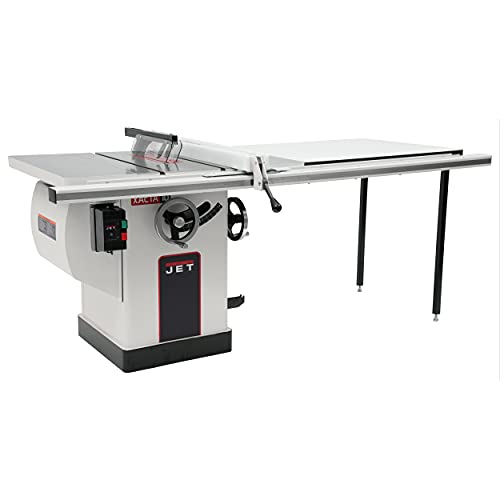
JET 10-Inch XACTA Table Saw with 50-Inch Rip
Best for: High-capacity rip cutting in fixed workshops
- Horsepower
- 3 HP (what this guide is about)
- Blade Diameter
- 10-Inch
- Rip Capacity
- 50-Inch
- Voltage
- 230V
- Dimensions
- 85 × 36 × 38 inches
- Weight
- 510 pounds
View on Amazon: JET 10-Inch XACTA Table Saw with 50-Inch Rip Affiliate link
This Jet table saw delivers 3 HP of power on 230V, making it a robust option for heavy-duty cutting. It features a 50-inch rip capacity and a 10-inch blade. The 510-pound weight and large footprint require significant floor space. You should choose this if you need extensive rip capacity and commercial-grade stability for your woodworking projects.
Pros
- 3 HP motor provides high torque for demanding cuts
- 50-inch rip capacity handles wide stock easily
- 230V electrical requirement suits dedicated shop circuits
- Poly-V drive belt ensures quiet and efficient operation
Cons
- 510-pound weight makes it difficult to move
- Requires 230V power, not standard 120V outlets
- Large footprint demands substantial workshop space
Good fit if
- You need a 50-inch rip capacity for wide boards
- You have a dedicated 230V circuit in your shop
- You prioritize stability and heavy-duty construction over portability
Skip if
- You only have standard 120V household outlets
- You have limited floor space for a large machine
- You need to frequently move the saw between locations
Verdict: Jet 10-Inch 3 HP Table Saw offers exceptional rip capacity and power for fixed workshop setups. It suits woodworkers who cut wide materials and have the space and electrical infrastructure to support its substantial size and weight.
Specifications side by side
| Spec | JET 14-Inch 1.75 HP Band Saw | JET 10-Inch XACTA Table Saw with 50-Inch Rip |
|---|---|---|
| Blade Diameter | not stated | 10-Inch |
| Rip Capacity | not stated | 50-Inch |
| Horsepower | 1.75 HP | 3 HP |
| Voltage | 115/230V | 230V |
| Cutting Width | 13-Inch | not stated |
| Dimensions | 75.5 × 27 × 37 inches | 85 × 36 × 38 inches |
| Weight | 272 pounds | 510 pounds |
| Color | White | White |
| Model | 714400K | JTAS-10XL50-1DX |
| Size | not stated | 10-Inch |
Frequently asked questions
Can a 1.75 HP saw cut through thick hardwood?
Yes, but it depends on the tool type. The JET 1.75 HP Band Saw handles thick stock up to 13 inches. It uses a 116-inch blade loop for deep resawing. This motor provides enough torque for heavy slabs. You cannot use this motor for standard table saw ripping duties. Choose it for vertical cutting tasks only.
Is 3 HP better than 1.75 HP for ripping?
For ripping wide boards, 3 HP is superior. The JET 10-Inch XACTA Table Saw features a 3 HP motor. It delivers high torque for continuous heavy cuts. The 1.75 HP unit is a band saw, not a table saw. Comparing them directly for ripping is incorrect. Use the 3 HP saw for wide sheet goods and thick lumber.
What is the main difference between these two tools?
The primary difference is their cutting method and capacity. One is a band saw for resawing thick material. The other is a table saw for ripping and crosscutting. The band saw has a 13-inch cutting width. The table saw has a 10-inch blade diameter. They serve different purposes in a workshop. Select based on your primary cutting needs.
Do I need a 230V outlet for the 3 HP saw?
Yes, the JET 10-Inch XACTA Table Saw requires 230V power. High horsepower motors draw more current. A standard 120V outlet may not support the load. Ensure your workshop has the correct electrical infrastructure. The 1.75 HP band saw has different power needs. Check your voltage requirements before installation to avoid tripping breakers.
Which saw is better for a small workshop?
Neither is ideal for very small spaces due to size. The 1.75 HP band saw weighs 272 pounds. The 3 HP table saw weighs 510 pounds. Both are fixed workshop machines. The table saw offers a 50-inch rip capacity. The band saw fits woodworkers who value stability. Consider your floor space and load-bearing capacity before purchasing either unit.
Can I use the 1.75 HP motor for table sawing?
No, that motor is part of a band saw. The JET 14-Inch 1.75 HP Band Saw is designed for vertical resawing. It drives a 116-inch blade loop. You cannot install this motor in a table saw. For table sawing, you need a dedicated table saw motor. The 3 HP JET XACTA is built for that specific application.
How much weight can these saws support?
The weight refers to the machine itself, not the load capacity. The 1.75 HP band saw weighs 272 pounds. The 3 HP table saw weighs 510 pounds. Heavier machines reduce vibration during operation. The table saw supports wide materials with its 50-inch rip capacity. Ensure your workbench or floor can handle these static weights safely.