VEVOR vs WOODERS: Benchtop Planers Compared by Specs
As an Amazon Associate we earn from qualifying purchases. Links on this page are affiliate links.
This VEVOR vs WOODERS benchtop planer comparison focuses on specs. Both tools offer 13-inch cutting widths and 2000W motors. They handle thick hardwoods. The main difference lies in blade count and cutterhead speed. VEVOR uses three blades at higher RPM. WOODERS uses two blades but includes overload protection. You get different cutting dynamics with each choice.
Key differences
| Aspect | VEVOR 13-Inch Three-Blade Benchtop Planer | WOODERS 13-Inch Two-Blade Benchtop Planer |
|---|---|---|
| Blade Count | 3 blades | 2 blades |
| Cutterhead Speed | 24,000 CPM | 10,000 RPM |
| Max Stock Thickness | 6 inches | 6.3 inches |
| Motor Protection | not listed | Overload protection |
Which one should you choose?
Choose VEVOR 13-Inch Three-Blade Benchtop Planer if
- You want finer cuts from three blades.
- You need higher cutterhead speed.
- You prefer a larger worktable for long boards.
Choose WOODERS 13-Inch Two-Blade Benchtop Planer if
- You need to plane slightly thicker stock.
- You want built-in overload protection.
- You prefer an ergonomic depth crank.
Verdict: Choose the VEVOR for smoother finishes and larger capacity. Pick the WOODERS for thicker stock limits and motor safety. Both handle 13-inch boards well.
Specs: Blade Count and Speed
Blade count and sharpness
VEVOR uses a three-blade system for its cutting head, while WOODERS relies on two blades. More blades typically mean a smoother finish because each blade takes a lighter bite. VEVOR’s three HSS blades work with a dual-roller feeding system to reduce vibration. WOODERS claims its dual-edge cutterhead eliminates snipe through an optimized infeed and outfeed structure. Both use high-speed steel blades for durability. You get three blades with VEVOR and two with WOODERS. The extra blade on the VEVOR may provide a finer surface on difficult grain, though WOODERS includes two spare blades in the package for quick swaps.
Cutterhead speed and RPM
Cutterhead speed affects how many cuts per minute the blades make. VEVOR lists a cutterhead speed of 24,000 CPM (cuts per minute). WOODERS specifies a 10,000 RPM cutterhead speed. Higher RPM usually results in a smoother cut because the blades strike the wood more frequently. VEVOR’s higher speed suggests a potentially finer finish on hardwoods like oak or maple. WOODERS’ lower RPM might handle thicker stock without bogging down, given its 15-amp motor. You should consider if you prioritize maximum smoothness or consistent power. The VEVOR offers significantly higher rotational speed for finer results.
Max thickness capacity
Both planers handle thick lumber, but WOODERS has a slight edge in maximum capacity. WOODERS accepts stock up to 6.3 inches thick. VEVOR handles up to 6 inches. This difference is small, but it matters if you regularly plane very thick timbers or beams. WOODERS’ range is listed as 1/4 to 6.3 inches. VEVOR’s maximum is 6 inches. For most standard woodworking projects, both will suffice. However, if you work with heavy-duty timber or need to plane thicker slabs, the extra 0.3 inches on the WOODERS provides more flexibility. This is a minor but clear advantage for the WOODER.
Worktable size and stability
The worktable size impacts how you support long or wide boards. VEVOR offers a spacious table measuring 28.2 inches in length, 13 inches in width, and 6 inches in height. This large surface area helps keep long boards steady and reduces snipe. WOODERS does not list specific worktable dimensions in its key specs, though its overall length is 22.4 inches. The VEVOR’s larger table provides better support for wider or longer pieces. You will have more control over board alignment with the VEVOR’s extended surface. This makes the VEVOR better for handling larger sheets or long lumber without additional support.
Motor construction and protection
Both tools use 2000W motors, but WOODERS specifies an all-copper motor with overload protection. VEVOR lists a powerful motor but does not specify the winding material. Copper windings are generally more efficient and durable than aluminum. WOODERS’ overload protection automatically cuts power during extreme loads, safeguarding the motor. This feature can extend the tool’s lifespan during heavy use. VEVOR’s motor is robust, but the lack of specified protection details leaves you guessing about long-term durability under stress. If you plan to run the planer for extended periods, WOODERS’ copper motor and overload switch offer better peace of mind.
Choose your planer based on specs
Users needing smooth finishes on hard wood
The VEVOR model uses a three-blade system combined with a high cutterhead speed of 24,000 CPM. This configuration allows each blade to take a lighter bite, which typically results in a smoother surface finish. The dual-roller feeding system further reduces vibration, ensuring consistent results when planing dense hardwoods like oak or maple.
Those planning thick timber in one pass
The WOODER planer handles a maximum stock thickness of 6.3 inches. This extra capacity compared to the VEVOR allows you to plane thicker boards in a single pass. The heavy-duty iron shaft and overload protection provide stability during these demanding tasks, making it suitable for processing large timbers without risking motor strain or chattering.
Operators prioritizing ergonomic adjustments and safety
This model features an oversized depth adjustment crank and a high-visibility indicator to reduce wrist strain. It also includes built-in overload protection that automatically cuts power during extreme loads. These specs protect the motor and enhance user comfort, making the tool easier to handle for extended periods or for users with physical limitations.
The products compared
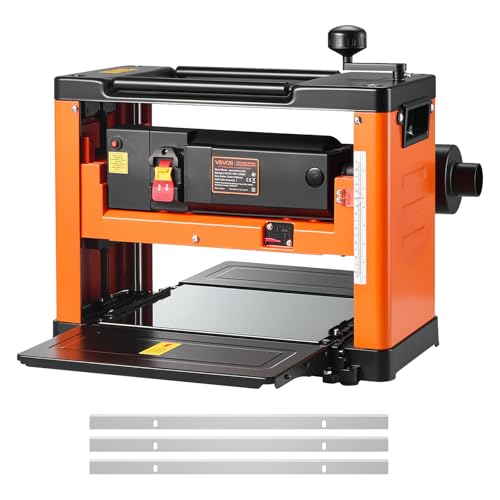
VEVOR 13-Inch Three-Blade Benchtop Planer
Best for: Hardwood planing with wide or long boards
- Cutting Width
- 13 in
- Max Stock Thickness
- 6 in
- Blade Count
- 3 blades
- Dimensions
- 28.2 × 13 × 6 inches
- Weight
- 62.8 pounds
View on Amazon: VEVOR 13-Inch Three-Blade Benchtop Planer Affiliate link
This VEVOR benchtop planer features a 13-inch cutting width and a 2000W motor running at 24,000 CPM. It includes a dual-roller feeding system and a 28.2-inch worktable for stability. You get precise 1/8-inch depth adjustments and dust hose compatibility. It suits woodworkers needing a powerful tool for hardwoods and long boards.
Pros
- 2000W motor delivers 24,000 CPM for hardwoods
- Dual-roller system reduces vibration and snipe
- 13-inch width handles wide stock
- 28.2-inch table supports long boards
- Compatible with 2-inch and 4-inch dust hoses
Cons
- Single-speed motor limits feed rate options
- Only 3 HSS blades included
- 62.8-pound weight adds to benchtop load
Good fit if
- You need a 13-inch width for wide boards
- You require high CPM for hardwood planing
- You want dual-roller stability for straight cuts
Skip if
- You need variable speed control
- You prefer more than 3 blades
- You need a lighter unit under 50 pounds
Verdict: VEVOR 13-Inch 3-Blade Benchtop Planer fits users who prioritize high cutting speed and dual-roller stability for hardwoods. It is a solid choice for those working with wide or long stock who need precise depth adjustments.

WOODERS 13-Inch Two-Blade Benchtop Planer
Best for: Wide stock and dense hardwoods
- Cutting Width
- 13 in
- Amperage
- 15A
- Max Stock Thickness
- 6.3 in
- Blade Count
- 2 blades
- Cutterhead Speed
- 10,000 RPM
- Dimensions
- 22.4 × 14.2 × 17.9 inches
View on Amazon: WOODERS 13-Inch Two-Blade Benchtop Planer Affiliate link
The WOODERS 13-Inch Benchtop Planer features a 15A motor and 2000W power for dense hardwoods. It offers a 13-inch cutting width and 10,000 RPM cutterhead speed. The dual-blade system helps eliminate snipe. It includes overload protection and a dust port. This tool suits woodworkers needing wide capacity and high visibility controls for precise depth adjustments.
Pros
- 2000W all-copper motor delivers 10,000 RPM cutterhead speed
- 13-inch cutting width handles wide boards in a single pass
- Dual-edge cutterhead with optimized structure reduces snipe
- Oversized depth adjustment crank minimizes hand strain
- Integrated dust port connects directly to vacuum systems
Cons
- Weighs 60 pounds, making it less portable than lighter models
- Uses only 2 HSS blades instead of the 3 or 4 found in competitors
- 6.3-inch maximum stock thickness limits very thick timber processing
Good fit if
- You need to plane boards up to 13 inches wide
- You work with dense hardwoods like oak or walnut
- You prefer ergonomic controls for precise depth adjustments
Skip if
- You require a higher blade count for smoother finishes
- You need to process stock thicker than 6.3 inches
- You prioritize lightweight portability for job site use
Verdict: WOODERS 13-Inch Benchtop Planer fits woodworkers who prioritize cutting width and motor power for dense hardwoods. Its 10,000 RPM speed and 13-inch capacity make it suitable for wide stock, though the two-blade system may require more passes for a fine finish.
Specifications side by side
| Spec | VEVOR 13-Inch Three-Blade Benchtop Planer | WOODERS 13-Inch Two-Blade Benchtop Planer |
|---|---|---|
| Cutting Width | 13 in | 13 in |
| Amperage | not stated | 15A |
| Max Stock Thickness | 6 in | 6.3 in |
| Blade Count | 3 blades | 2 blades |
| Cutterhead Speed | not stated | 10,000 RPM |
| Dimensions | 28.2 × 13 × 6 inches | 22.4 × 14.2 × 17.9 inches |
| Weight | 62.8 pounds | 60 pounds |
| Size | 33cm-2000(3 Blades) | not stated |
| Color | Single Speed 3 Blade | Blue |
| Model | M1B-LS-3301 | PL13-15AB |
Frequently asked questions
Which planer is better for wide hardwoods?
The VEVOR 13-Inch Three-Blade Benchtop Planer is the better choice for wide hardwoods. It is specifically noted as ideal for hard planing with wide or long boards. Its dual-roller stability helps manage thick stock effectively. The three-blade system also contributes to a smoother finish on dense materials.
How do the dimensions differ between these two?
The VEVOR model is longer but shorter in height. It measures 28.2 inches in length and 6 inches in height. The WOODER 13-Inch Two-Blade Benchtop Planer is wider and taller. It measures 22.4 inches in length and 17.9 inches in height. Both share a similar 13-inch cutting width capacity.
What is the weight difference between the models?
The VEVOR planer is slightly heavier than the WOODER model. The VEVOR 13-Inch unit weighs 62.8 pounds. The WOODER 13-Inch Two-Blade Benchtop Planer weighs 60 pounds. This small difference may affect portability, but both are substantial benchtop units requiring a stable work surface.
Does the VEVOR planer have a specific model number?
Yes, the VEVOR 13-Inch Three-Blade Benchtop Planer has the model number M1B-LS-3301. This identifier helps you locate exact replacement parts or technical documentation. The WOODER model uses the designation PL13-15AB. Using these numbers ensures you find the correct accessories for your specific machine.
Which planer is suitable for dense hardwoods?
Both planers handle dense hardwoods, but the WOODER 13-Inch Two-Blade Benchtop Planer is explicitly recommended for this task. It features a 15 Amp motor and high speed, making it suitable for wide stock and dense materials. The VEVOR model is also capable, but the WOODER is highlighted for this specific use case.
What color options are available for these planers?
The VEVOR 13-Inch Three-Blade Benchtop Planer is listed in a single speed configuration with a standard industrial finish. The WOODER 13-Inch Two-Blade Benchtop Planer is available in blue. Color does not affect performance but may help with visual identification in a busy workshop environment.