Powermatic 14-Inch Table Saw vs Powermatic 10-Inch 5 HP Table Saw (2026): Key Differences
As an Amazon Associate we earn from qualifying purchases. Links on this page are affiliate links.
Comparing the powermatic 14 inch table saw vs 10 inch 5 hp table saw reveals distinct industrial choices. Both models share a 50-inch rip capacity and the ArmorGlide coating for low friction. They also use one-piece cast iron trunnions for stability. The main difference lies in their motor power and blade size. The 14-inch model offers 7.5 HP and three-phase power. The 10-inch version provides 5 HP on single-phase power. You need to weigh power needs against electrical constraints.
Key differences
| Aspect | Powermatic 14-Inch Table Saw with 50-Inch Rip | Powermatic 10-Inch 5 HP Table Saw with Workbench |
|---|---|---|
| Blade Diameter | 14-Inch | 10-Inch |
| Horsepower | 7-1/2 HP | 5 HP |
| Voltage | 230/460V 3Ph | 230V 1Ph |
| Weight | 737 pounds | 690 pounds |
Which one should you choose?
Choose Powermatic 14-Inch Table Saw with 50-Inch Rip if
- You have access to 460V three-phase power in your shop.
- You require maximum cutting power for dense hardwoods with a 14-inch blade.
- You prefer a push-button arbor lock for rapid blade changes.
Choose Powermatic 10-Inch 5 HP Table Saw with Workbench if
- You are limited to standard 230V single-phase electrical circuits.
- You want a saw that is slightly lighter and easier to move with hydraulic casters.
- You need an integrated digital readout for precise bevel cuts.
Verdict: The 14-inch model suits shops with industrial three-phase power and a need for maximum torque. The 10-inch model is better for standard workshops requiring single-phase operation and easier mobility. Both provide the same high-quality table surface and stability features.
Specs and Build Differences
Blade Diameter
The Powermatic 14-Inch Table Saw features a 14-inch blade diameter, while the Powermatic 10-Inch 5 HP Table Saw uses a 10-inch blade. A larger blade allows for greater cutting depth and can handle thicker stock without needing to flip the material. The 14-inch model is designed for heavy-duty industrial tasks requiring deep cuts. The 10-inch model offers standard capacity for most woodworking projects. Choose the 14-inch saw if you frequently work with thick hardwoods or require maximum depth of cut capability.
Horsepower
Motor power differs significantly between these two units. The Powermatic 14-Inch Table Saw is equipped with a 7-1/2 HP motor. The Powermatic 10-Inch 5 HP Table Saw has a 5 HP motor. Higher horsepower provides more torque, which helps maintain blade speed under heavy loads. This is crucial when cutting dense materials or making deep cuts. The 7-1/2 HP motor in the 14-inch model offers superior power for demanding industrial applications. The 5 HP motor is sufficient for general shop use but may struggle with very thick or hard stock compared to the larger unit.
Voltage
Electrical requirements vary for each saw. The Powermatic 14-Inch Table Saw operates on 230/460V 3-Phase power. The Powermatic 10-Inch 5 HP Table Saw runs on 230V 1-Phase power. Three-phase power is common in industrial settings and can provide smoother operation for larger motors. Single-phase power is more accessible in standard workshops. You must ensure your shop has the correct electrical supply for the model you choose. The 14-inch saw requires a three-phase connection, which may limit where you can place it if your shop lacks that infrastructure.
Weight
Both saws are heavy, but they differ slightly in mass. The Powermatic 14-Inch Table Saw weighs 737 pounds. The Powermatic 10-Inch 5 HP Table Saw weighs 690 pounds. The 14-inch model is 47 pounds heavier. This extra weight comes from the larger motor and potentially heavier internal components. Heavier machines vibrate less during operation, which can improve cut quality. However, the 14-inch saw is more difficult to move. The 10-inch model is slightly lighter, making it marginally easier to reposition if your shop layout changes, though both require significant effort to move.
Features
Each model includes unique features to aid operation. The Powermatic 14-Inch Table Saw has a push-button arbor lock for rapid blade changes and an adjustable angle indicator on the blade bevel scale. The Powermatic 10-Inch 5 HP Table Saw includes an integrated digital readout for precise bevel cuts and a hydraulic caster system for ease of movement. The digital readout on the 10-inch model offers higher precision for setting angles. The hydraulic casters on the 10-inch model make moving the saw much easier than the 14-inch model, which lacks this mobility aid.
Which powermatic table saw fits your shop
Heavy-duty production shop needing maximum power
This model delivers 7-1/2 HP on 230/460V three-phase power. The 14-inch blade handles thicker stock with ease. The robust Poly-V drive belt ensures quiet, efficient operation during long cuts. Its 737-pound weight and one-piece cast iron box trunnion provide unmatched stability for continuous industrial use.
Shop with limited single-phase electrical supply
This saw runs on standard 230V single-phase power, making it accessible for most workshops. It includes a workbench for added utility and hydraulic casters for easier movement. The 5 HP motor paired with a 10-inch blade offers precise control and sufficient power for detailed woodworking tasks without requiring specialized electrical infrastructure.
User prioritizing precise digital angle adjustments
This model features an integrated digital readout for bevel cuts, ensuring high accuracy. The precision-ground cast iron tabletop includes front and rear edge bevels for better alignment. Combined with the one-handed arbor lock for quick blade changes, this setup streamlines your workflow and reduces setup time for complex angled cuts.
The products compared

Powermatic 14-Inch Table Saw with 50-Inch Rip
Best for: Industrial 3-phase workshops needing wide rips
- Blade Diameter
- 14-Inch
- Rip Capacity
- 50-Inch
- Horsepower
- 7-1/2 HP
- Voltage
- 230/460V
- Dimensions
- 84.8 × 39.1 × 40.4 inches
- Weight
- 737 pounds
View on Amazon: Powermatic 14-Inch Table Saw with 50-Inch Rip Affiliate link
This Powermatic model features a 14-inch blade and 7.5 HP motor for heavy industrial cutting. It offers a 50-inch rip capacity and runs on 230/460V 3-phase power. The 737-pound cast iron construction provides exceptional stability. You need a dedicated shop for this size. It suits professionals requiring maximum precision and wide material handling.
Pros
- 7.5 HP motor delivers high power
- 50-inch rip capacity handles wide stock
- One-piece cast iron box trunnion ensures stability
- Low-friction industrial-grade coating resists rust
Cons
- Requires 230/460V 3-phase electrical supply
- Weighs 737 pounds, making it immovable
- Dimensions exceed standard workshop spaces
Good fit if
- You have a dedicated industrial workshop
- You routinely cut wide lumber
- You have access to 3-phase power
Skip if
- You need a portable tool
- Your shop only has 110V outlets
- You have limited floor space
Verdict: Powermatic 14-Inch 7.5 HP Table Saw fits professional shops with 3-phase power. It handles wide rip cuts with industrial stability.
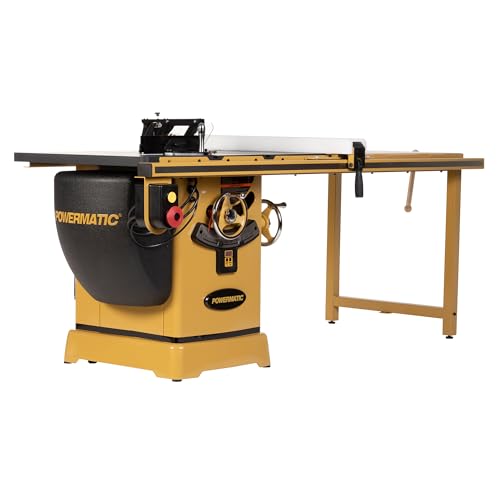
Powermatic 10-Inch 5 HP Table Saw with Workbench
Best for: Ripping wide panels with high stability
- Blade Diameter
- 10-Inch
- Rip Capacity
- 50-Inch
- Horsepower
- 5 HP
- Voltage
- 230V
- Dimensions
- 84.8 × 39.1 × 40.4 inches
- Weight
- 690 pounds
View on Amazon: Powermatic 10-Inch 5 HP Table Saw with Workbench Affiliate link
This Powermatic model features a 10-inch blade and a 5 HP motor running on 230V power. It offers a 50-inch rip capacity, which is substantial for wide panels. The 690-pound cast iron construction provides stability. The integrated digital readout helps you set precise bevel angles. It suits shops that need heavy-duty performance and large material handling capabilities.
Pros
- 5 HP motor for robust cutting power
- 50-inch rip capacity for wide stock
- Integrated digital readout for precise bevels
- Hydraulic caster system for shop mobility
Cons
- Heavier at 690 pounds than the 14-inch competitor
- Smaller 10-inch blade limits maximum cut depth
- Requires 230V electrical connection
Good fit if
- You need to rip very wide sheets of material
- You have 230V power available in your shop
- You prefer the stability of a heavy cast iron base
Skip if
- You only have standard 120V outlets
- You need to cut thick stock deeper than 10-inch blade allows
- You want a lighter saw for frequent relocation
Verdict: Powermatic 10-Inch 5 HP Table Saw delivers high rip capacity and stability for wide workpieces, making it ideal for shops prioritizing panel processing over maximum blade height.
Specifications side by side
| Spec | Powermatic 14-Inch Table Saw with 50-Inch Rip | Powermatic 10-Inch 5 HP Table Saw with Workbench |
|---|---|---|
| Blade Diameter | 14-Inch | 10-Inch |
| Rip Capacity | 50-Inch | 50-Inch |
| Horsepower | 7-1/2 HP | 5 HP |
| Voltage | 230/460V | 230V |
| Dimensions | 84.8 × 39.1 × 40.4 inches | 84.8 × 39.1 × 40.4 inches |
| Weight | 737 pounds | 690 pounds |
| Color | Gold | Gold |
| Model | PM3000T | PM2000T |
Frequently asked questions
How much does the Powermatic 14-Inch Table Saw weigh compared to the 10-Inch model?
The 14-Inch model weighs 737 pounds, while the 10-Inch version weighs 690 pounds. This 47-pound difference reflects the larger frame and heavier components of the 14-Inch saw. Both machines are extremely heavy, so you will need a reinforced floor and proper lifting equipment to move them safely into your shop.
What is the maximum rip capacity for both Powermatic table saws?
Both saws offer a 50-inch rip capacity. This allows you to process wide panels and large sheet goods without needing additional support structures. The extended table length accommodates these wide cuts, making both models suitable for industrial-scale woodworking tasks that require handling broad workpieces.
Does the Powermatic 14-Inch Table Saw require three-phase power?
Yes, the 14-Inch model is designed for 230/460V three-phase power. This electrical requirement is standard for high-horsepower industrial machinery. You must ensure your workshop has the correct electrical infrastructure before installation. The 10-Inch model operates on 230V single-phase power, which is more common in standard shops.
What drive system do these Powermatic saws use?
Both saws utilize a Poly-V drive belt system. This design ensures quiet and efficient operation during long cutting sessions. The belt transfers power from the motor to the blade with minimal vibration. This contributes to the overall stability and smooth performance expected from professional-grade table saws.
How does the blade diameter affect cutting depth?
The 14-Inch blade allows for greater cutting depth than the 10-Inch blade. This enables you to cut through thicker stock without flipping the material. The larger diameter provides more vertical clearance. If you frequently work with thick lumber, the 14-Inch model offers a distinct advantage in vertical capacity.
What coating is applied to the table surface of these saws?
Both models feature an ArmorGlide coating on the table surface. This coating reduces friction, allowing your workpieces to slide smoothly during cuts. It helps maintain accuracy and reduces effort when pushing material through the blade. The gold-colored finish also protects the cast iron from rust and wear.
Are the trunnions made of one-piece cast iron?
Yes, both saws use one-piece cast iron trunnions. This construction provides exceptional stability and reduces vibration during operation. The solid base supports the blade assembly securely. This design choice ensures precise cuts and long-term durability, which is critical for professional woodworking applications.