PioneerWorks 8-Inch Bandsaw or PioneerWorks Table Saw Jobsite 8-inch? Which PioneerWorks Model to Buy
As an Amazon Associate we earn from qualifying purchases. Links on this page are affiliate links.
This guide compares the PioneerWorks 8 inch bandsaw vs table saw jobsite 8 inch. Both tools share an 8-inch blade size and orange finishes. They differ significantly in function. The table saw focuses on straight crosscuts and bevels for jobsite work. The bandsaw handles curves and angled cuts for benchtop use. You need to match the tool to your specific cutting needs.
Key differences
| Aspect | PioneerWorks 8-Inch Portable Table Saw | PioneerWorks 8-Inch Benchtop Band Saw |
|---|---|---|
| Amperage | 6.7 Amp | 3 Amp |
| No-Load Speed | 3576 RPM | 1800 RPM |
| Weight | 36 pounds | 40.1 pounds |
| Cutting Width | not listed | 8 inches |
| Cutting Height (90°) | not listed | 80mm |
Which one should you choose?
Choose PioneerWorks 8-Inch Portable Table Saw if
- You need higher speed for fast crosscuts.
- You prefer a lighter tool for transport.
- You want adjustable bevel angles for framing.
Choose PioneerWorks 8-Inch Benchtop Band Saw if
- You need to cut curved shapes.
- You want to cut soft metals like aluminum.
- You require a wider cutting capacity for stock.
Verdict: Choose the table saw if your work involves straight cuts and portability. Pick the bandsaw if you need to cut curves or softer metals. Both tools serve distinct purposes in woodworking.
Key Specs Comparison Guide
Motor power
The PioneerWorks 8-Inch Portable Table Saw uses a 6.7-amp motor, while the PioneerWorks 8-Inch Benchtop Band Saw features a 3-amp motor. Higher amperage generally indicates more torque and cutting force for demanding tasks. The table saw’s 6.7-amp rating suggests it can handle thicker or harder materials with less strain. The bandsaw’s 3-amp motor is sufficient for its specific cutting style but offers less raw power. If you need robust performance for dense lumber, the table saw has the advantage. For lighter, detailed work, the lower power of the bandsaw is adequate.
No-load speed
Speed settings differ between the two models. The table saw operates at 3576 RPM, whereas the bandsaw runs at 1800 RPM. Higher RPM on a table saw typically allows for faster feed rates on straight cuts. The bandsaw’s lower speed is designed for smooth, continuous cutting through curves and complex shapes. Faster speeds do not always mean better results, as they can affect cut quality. You should choose based on your primary cutting style. The table saw is faster for linear cuts, while the bandsaw’s speed is optimized for precision in curved work.
Portability
Weight and size impact how easy the tools are to move. The table saw weighs 36 pounds and measures 13.5 x 14 x 13 inches. The bandsaw is heavier at 40.1 pounds and taller at 28 inches high. The table saw’s compact footprint and lighter weight make it easier to transport on a jobsite. The bandsaw’s height and weight make it less portable. If you frequently move your equipment between locations, the table saw is the better choice. Its carry handle also aids in transport. The bandsaw is better suited for a fixed bench location.
Dust collection
Both tools address dust, but with different efficiencies. The table saw claims a 98.5% dust collection rate, which is a specific metric for its system. The bandsaw mentions a dust exhaust port and a brush to minimize debris. The table saw’s high percentage suggests a more effective containment system for cleaner air. The bandsaw relies on physical barriers and ports. For a cleaner workspace, the table saw’s stated performance is superior. You will likely experience less airborne dust with the table saw. The bandsaw requires manual cleaning of the brush area more often.
Cutting versatility
Functionality defines the primary use of each tool. The table saw is designed for 90-degree crosscuts and 0-45-degree bevels. It excels at straight, rip, and cross cuts. The bandsaw can cut straight lines, curves, and multi-angles. It handles wood, metal, copper, aluminum, and plastic. If you need to cut intricate shapes or non-wood materials, the bandsaw is the only option. For standard woodworking joints and straight cuts, the table saw is faster. The bandsaw offers material versatility, while the table saw offers precision for wood.
Choose the Right PioneerWorks Tool
Jobsite carpenters needing portability
This table saw weighs 36 pounds and measures 13.5 by 14 by 13 inches. Its compact size fits easily in a truck. The 6.7-amp motor delivers 3576 RPM for fast cuts. You get efficient dust collection and a carry handle. It is built for moving between sites while maintaining high cutting speed and power.
Shop users cutting curves
This bandsaw handles curves and complex shapes. It features a 3-amp motor running at 1800 RPM. The cutting capacity reaches 8 inches wide. The sturdy steel base minimizes vibration during use. You gain access to a spacious 11.81 by 11.81 inch work surface for stable material support during detailed work.
DIYers making furniture parts
You need precise straight cuts for furniture assembly. This table saw offers 90-degree crosscuts and 0 to 45-degree bevels. The 6.7-amp motor ensures clean cuts through various wood sizes. The transparent blade guard keeps you safe. Adjustable height settings allow you to tailor the cut depth for your specific project requirements.
The products compared
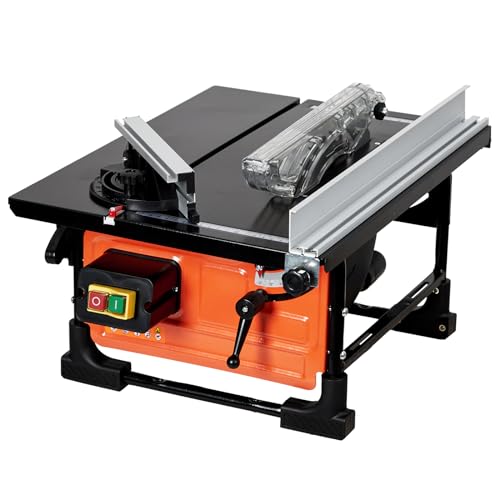
PioneerWorks 8-Inch Portable Table Saw
Best for: portable DIY wood cutting projects
- Blade Diameter
- 8-inch
- Amperage
- 6.7-Amp
- No-Load Speed
- 3576 RPM
- Intended Use
- Jobsite, DIY Projects
- Dimensions
- 14 × 13.5 × 13 inches
- Weight
- 36 pounds
View on Amazon: PioneerWorks 8-Inch Portable Table Saw Affiliate link
This PioneerWorks jobsite table saw features a 6.7-amp copper motor and an 8-inch blade. It reaches a no-load speed of 3576 RPM for fast cuts. The unit weighs 36 pounds and includes a carry handle for transport. It offers 90-degree cross cuts and 0 to 45-degree bevel adjustments. The dust collection system claims a 98.5% capture rate. It suits DIYers needing portable precision for wood processing.
Pros
- 6.7-amp pure copper motor delivers high-speed cutting
- Compact 36-pound build with integrated carry handle
- Adjustable blade angle for 0-45 degree bevel cuts
Cons
- 8-inch blade diameter limits cutting capacity
- No mention of laser guide or fence system
- Single speed motor lacks variable control
Good fit if
- You need a lightweight saw for job site transport
- You require bevel cutting angles for angled projects
- You want a compact unit for small workshops
Skip if
- You need to cut wide boards beyond 8 inches
- You require variable speed control for delicate materials
- You prefer a stationary cabinet saw for heavy duty work
Verdict: PioneerWorks 8-Inch Jobsite Table Saw fits DIYers who prioritize portability and bevel flexibility. It handles standard wood cutting tasks efficiently without the bulk of larger models.

PioneerWorks 8-Inch Benchtop Band Saw
Best for: Detailed curved and angled cutting
- Amperage
- 3 A
- No-Load Speed
- 1,800 RPM
- Blade Diameter
- 8-Inch
- Dimensions
- 17 × 12 × 28 inches
- Weight
- 40.1 pounds
View on Amazon: PioneerWorks 8-Inch Benchtop Band Saw Affiliate link
This is a benchtop bandsaw with an 8-inch cutting width and a 3-amp pure copper motor. It runs at 1,800 RPM and features a tilting table for multi-angle cuts up to 45 degrees. The 40.1-pound steel base provides stability. It suits users needing portable precision for wood and soft metals.
Pros
- 3-amp pure copper motor for efficient cutting
- 8-inch cutting width with 3.5-inch height capacity
- 1,800 RPM no-load speed for neat cuts
- 0-45 degree tilting table for multi-angle work
- Double safety switch for secure operation
Cons
- Lower 3-amp motor compared to 6.7-amp jobsite table saws
- 40.1-pound weight limits portability
- No data on included blade types or accessories
Good fit if
- You need precise curved or angled cuts
- You work with wood and soft metals
- You want a stable benchtop unit
Skip if
- You require high-power ripping of thick lumber
- You need a portable jobsite table saw
- You prioritize maximum cutting speed above all
Verdict: PioneerWorks 8-Inch Benchtop Bandsaw offers stable, precise cutting for detailed projects. It fits woodworkers needing angled cuts rather than rapid material removal.
Specifications side by side
| Spec | PioneerWorks 8-Inch Portable Table Saw | PioneerWorks 8-Inch Benchtop Band Saw |
|---|---|---|
| Blade Diameter | 8-inch | not stated |
| Amperage | 6.7-Amp | 3 A |
| No-Load Speed | 3576 RPM | 1,800 RPM |
| Intended Use | Jobsite, DIY Projects | not stated |
| Dimensions | 14 × 13.5 × 13 inches | 17 × 12 × 28 inches |
| Weight | 36 pounds | 40.1 pounds |
| Color | Orange | Orange |
| Model | 01 | 01 |
Frequently asked questions
Can the PioneerWorks 8-inch table saw cut curves?
No, this model is designed for straight cuts. It features a 6.7-amp motor and 3576 RPM speed for efficient crosscuts and bevels. You should use the benchtop bandsaw if you need to cut curves or angles. The table saw prioritizes speed and portability for jobsite work over intricate shaping.
Which PioneerWorks tool is better for detailed woodworking?
The PioneerWorks 8-inch Benchtop Band Saw is better for detailed work. It is built for stable, precise cutting of curves and angled shapes. The table saw focuses on rapid material removal for standard tasks. If your projects require intricate designs, the bandsaw provides the necessary control and stability.
How much space does the PioneerWorks 8-inch table saw take up?
The table saw measures 13.5 inches wide, 14 inches long, and 13 inches high. It weighs 36 pounds, making it easy to transport. This compact footprint fits easily in a truck or small workshop. The bandsaw is taller at 28 inches but narrower, requiring different storage considerations.
Does the PioneerWorks 8-inch bandsaw have a powerful motor?
The bandsaw uses a 3-amp motor, which is less powerful than the table saw’s 6.7-amp unit. This lower amperage supports stable, precise cutting rather than rapid removal. It is suitable for detailed projects where control matters more than raw speed. The table saw offers more torque for demanding jobsite tasks.
Is the PioneerWorks 8-inch table saw heavy to carry?
It weighs 36 pounds, which is manageable for one person. Its compact dimensions allow it to fit in most vehicle beds. The bandsaw is slightly heavier at 40.1 pounds. Both tools are designed for portability, but the table saw’s lower weight makes it easier to move frequently on jobsites.
Can I use the PioneerWorks 8-inch bandsaw for ripping lumber?
The bandsaw is not ideal for ripping long pieces of lumber. It excels at curved cuts and angled shapes. The table saw is the better choice for ripping and straight crosscuts. Its 3576 RPM speed and 6.7-amp motor handle standard wood cutting tasks more efficiently for linear cuts.