MarvTool 10-inch Sliding Compound Miter vs MarvTool 15Amp Portable Table Saw (2026): Key Differences
As an Amazon Associate we earn from qualifying purchases. Links on this page are affiliate links.
You are comparing the marvtool 10 inch sliding compound miter vs 15amp portable table saw. Both tools share a 10-inch blade and a 15-amp motor. The main difference lies in their cutting style. The miter saw excels at angled crosscuts and bevels. The table saw handles rip cuts and sheet goods. Your choice depends on the specific cuts you need to make most often.
Key differences
| Aspect | MarvTool 10-Inch Sliding Compound Miter Saw | MarvTool 10-Inch Portable Table Saw |
|---|---|---|
| No-Load Speed | 5000 RPM | 4600 RPM |
| Weight | 25.6 pounds | 28.3 pounds |
| Dimensions (L x W x H) | 25.3 x 18.5 x 20.4 inches | 41.3 x 33.6 x 32.3 inches |
| Cutting Capacity (90 degrees) | Not listed | 3.4 inches |
| Bevel Range | 0 to 45 degrees | Not listed |
Which one should you choose?
Choose MarvTool 10-Inch Sliding Compound Miter Saw if
- You need precise angled crosscuts or bevel cuts for trim and molding.
- You require a lighter tool that is easier to move around a job site.
- You want a faster blade speed for cleaner cuts in softer materials.
Choose MarvTool 10-Inch Portable Table Saw if
- You need to rip long boards or cut large sheets of plywood.
- You require a larger working surface to support wide materials.
- You want a tool designed for straight, repetitive cuts through thick stock.
Verdict: Choose the miter saw if your work focuses on angles and trim. Pick the table saw if you need to rip lumber or cut large panels. Both tools offer 15 amps of power, so select based on your primary cutting geometry.
Miter Saw vs Table Saw Specs
No-load speed
The MarvTool 10-Inch Sliding Compound Miter Saw spins at 5000 RPM. The MarvTool 10-Inch Portable Table Saw runs at 4600 RPM. Both tools use 15-amp motors, but the miter saw offers higher rotational speed. This difference may affect cut quality in softwoods. Higher RPM often means a cleaner finish on crosscuts. The table saw’s lower speed is typical for ripping tasks. You should choose based on your primary material. If you cut delicate trim, the miter saw’s speed is an advantage. For general ripping, the difference is less critical. Both speeds are within standard ranges for 10-inch blades.
Cutting depth
The Portable Table Saw can cut boards up to 3.4 inches thick at 90 degrees. It handles 2.1 inches at 45 degrees. The Miter Saw’s cutting depth is not listed in the provided data. This makes a direct comparison difficult for thick stock. If you need to rip thick lumber, the table saw’s capacity is a clear benefit. The miter saw is designed for crosscuts and miters, not thick ripping. You should verify the miter saw’s maximum depth if you plan to cut wide boards. For standard framing and trim, both tools are sufficient. The table saw offers more flexibility for thick materials.
Weight and portability
The Miter Saw weighs 25.6 pounds. The Portable Table Saw weighs 28.3 pounds. The miter saw is lighter by 2.7 pounds. Both tools are designed for portability, but the miter saw is slightly easier to carry. The miter saw also features a compact design that locks into the base for storage. This maximizes space efficiency. The table saw is compact for its class but heavier. You will find the miter saw easier to transport on job sites. The weight difference is minor but noticeable when moving frequently. Both tools fit in standard vehicle trunks.
Blade diameter
Both tools feature a 10-inch blade diameter. The Miter Saw includes a 36-tooth carbide-tipped blade. The Table Saw also comes with a 36-tooth blade. This shared specification means they offer similar cutting performance for crosscuts and rip cuts. The tooth count suggests a balance between speed and finish. You can use the same replacement blades for both if needed. This compatibility simplifies maintenance. There is no advantage for either product in this category. The 10-inch size is standard for both miter and table saws. It provides a good balance of capacity and maneuverability.
Dimensions
The Miter Saw measures 18.5 inches wide, 20.4 inches high, and 25.3 inches long. The Portable Table Saw measures 33.6 inches wide, 32.3 inches high, and 41.3 inches long. The table saw is significantly larger in all dimensions. This makes the miter saw much more suitable for small workshops or tight spaces. The table saw requires more floor space and storage room. You should consider your available workspace before choosing. The miter saw’s compact footprint is a major advantage for limited areas. The table saw’s size supports its function but reduces portability.
Which tool fits your needs
Woodworkers needing angled cuts
You need precise miter and bevel angles. This saw cuts from 0 to 45 degrees on both axes. It spins at 5000 RPM for clean crosscuts. Weighing 25.6 pounds, it is easy to move. The included vise clamp holds material steady for accurate repeated cuts.
Users cutting thick materials
You require deep cutting capacity. This table saw handles boards up to 3.4 inches thick at 90 degrees. It also cuts 2.1 inches at 45 degrees. The 15-amp motor drives a 36-tooth blade at 4600 RPM. This setup is ideal for heavy-duty ripping and crosscuts.
Portability focused buyers
You value lightweight transport. This miter saw weighs only 25.6 pounds. Its compact design allows the head to lock into the base for storage. Measuring 25.3 inches long, it fits in small vehicles. The included extension tables add stability without adding significant bulk to your load.
The products compared
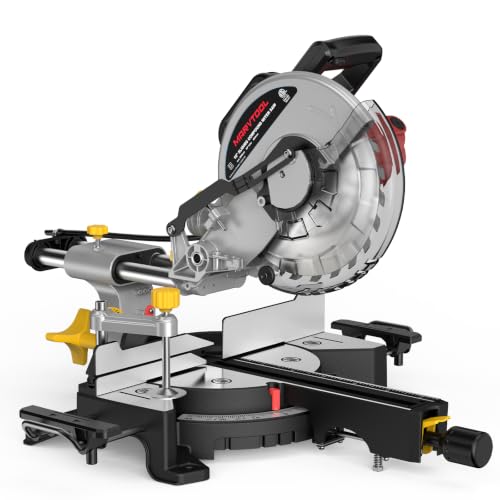
MarvTool 10-Inch Sliding Compound Miter Saw
Best for: Portable single bevel compound cutting tasks
- Blade Diameter
- 10-inch
- Amperage
- 15 Amp
- No-Load Speed
- 5000RPM
- Dimensions
- 25.3 × 18.5 × 20.4 inches
- Weight
- 25.6 pounds
View on Amazon: MarvTool 10-Inch Sliding Compound Miter Saw Affiliate link
This MarvTool miter saw features a 10-inch blade running at 5000 RPM. It offers a 15-amp motor for consistent power. The design supports left miter angles from 0° to 45° and bevel cuts from 0° to 45°. Weighing 25.6 pounds, it includes extension tables and a dust collection bag. You get a 2-year warranty and 24/7 support. This compact tool suits users needing versatile compound cuts in a portable package.
Pros
- 15-amp motor delivers 5000 RPM no-load speed
- Supports 0° to 45° left miter and bevel cuts
- Includes two extension tables and a dust bag
- Lightweight 25.6-pound design with locking release knob
Cons
- Single bevel capability limits cut angles compared to dual bevel models
- Handle is not pre-installed and requires assembly
- Transparent blade guard may reduce visibility in bright light
Good fit if
- You need precise compound cuts for trim or molding
- You require a lightweight saw for job site transport
- You want included extension tables for wider material support
Skip if
- You require dual bevel cutting for complex angles
- You prefer a saw with a pre-installed handle
- You need a sliding miter saw for long boards
Verdict: MarvTool 10-Inch Sliding Miter Saw provides reliable 5000 RPM cutting power for users needing single bevel versatility. It fits those who prioritize portability and included accessories over dual bevel capabilities.

MarvTool 10-Inch Portable Table Saw
Best for: portable crosscutting and thin materials
- Blade Diameter
- 10 inch
- Amperage
- 15 amp
- No-Load Speed
- 4600 RPM
- Cutting Depth 90
- 3.4 inches
- Intended Use
- DIY Projects
- Dimensions
- 41.3 × 33.6 × 32.3 inches
View on Amazon: MarvTool 10-Inch Portable Table Saw Affiliate link
This MarvTool table saw features a 15-amp motor running at 4600 RPM with a 10-inch, 36-tooth blade. It weighs 28.3 pounds and measures 41.3 by 33.6 inches. The unit cuts up to 3.4 inches thick at 90 degrees. Its compact design suits job sites and workshops. You get a transparent blade guard and a dust port for debris management.
Pros
- 15-amp motor delivers 4600 RPM for efficient cutting
- Lightweight 28.3-pound build aids portability
- Transparent blade guard improves visibility and safety
- Dust port connects to a vacuum for cleaner work
Cons
- 36-tooth blade is optimized for crosscuts, not fine rip cuts
- 3.4-inch cutting depth at 90 degrees limits thick stock
- No integrated fence system listed in specifications
Good fit if
- You need a lightweight saw for job site transport
- You primarily cut plywood, OSB, or thin aluminum
- You want a compact unit for small workshops
Skip if
- You require high-precision rip cuts for hardwoods
- You need to cut material thicker than 3.4 inches
- You prefer a stationary cabinet-style saw
Verdict: MarvTool 10-Inch 15Amp Portable Table Saw fits DIYers needing a lightweight, portable saw for crosscuts and thin materials. It is not suitable for heavy-duty rip cutting or thick stock.
Specifications side by side
| Spec | MarvTool 10-Inch Sliding Compound Miter Saw | MarvTool 10-Inch Portable Table Saw |
|---|---|---|
| Blade Diameter | 10-inch | 10 inch |
| Amperage | 15 Amp | 15 amp |
| No-Load Speed | 5000RPM | 4600 RPM |
| Cutting Depth 90 | not stated | 3.4 inches |
| Intended Use | not stated | DIY Projects |
| Dimensions | 25.3 × 18.5 × 20.4 inches | 41.3 × 33.6 × 32.3 inches |
| Weight | 25.6 pounds | 28.3 pounds |
| Size | 10" | not stated |
| Color | Black Yellow | Black |
| Model | JS-1013C4 | MJT255VC1 |
Frequently asked questions
Which saw is lighter and easier to move around?
The MarvTool 10-Inch Sliding Compound Miter Saw is lighter. It weighs 25.6 pounds. The portable table saw weighs 28.3 pounds. Both tools are designed for portability. The miter saw is also more compact. Its dimensions are 25.3 inches in length. This makes it simpler to carry and store.
Do both tools use the same blade size?
Yes, both tools use a 10-inch blade. This is the standard size for most workshop saws. It allows you to cut through wide boards. The miter saw spins at 5000 RPM. The table saw runs at 4600 RPM. The blade diameter is identical for both models.
Is the miter saw better for angled cuts?
Yes, the miter saw is built for angles. It handles sliding compound cuts well. You can adjust both miter and bevel angles. The table saw is primarily for straight cuts. It is not designed for complex angled work. Choose the miter saw for trim and framing angles.
Can the table saw handle thick wood stock?
The table saw is not ideal for thick stock. It is best for thin materials and crosscuts. The miter saw handles various thicknesses for crosscuts. Neither tool is for heavy-duty ripping. The table saw is lightweight and portable. It suits DIY projects more than construction sites.
What is the difference in motor speed?
The miter saw spins faster at 5000 RPM. The table saw runs at 4600 RPM. Both have 15-amp motors. The higher speed on the miter saw may help with cleaner cuts. The table saw has a lower RPM. This difference affects how each tool cuts material.
Which tool takes up less space in a garage?
The miter saw takes up less space. It is 25.3 inches long and 18.5 inches wide. The table saw is 41.3 inches long. It is much wider at 33.6 inches. The miter saw is easier to store. Its compact size fits small workshops better than the table saw.
Are both saws suitable for DIY projects?
Yes, both are suitable for DIY tasks. The table saw is explicitly intended for DIY projects. The miter saw fits portable single bevel tasks. Both are lightweight for home use. The miter saw weighs 25.6 pounds. The table saw weighs 28.3 pounds. They are easy to handle for hobbyists.