DEWALT vs RYOBI Table Saws: Which Brand Fits You?
As an Amazon Associate we earn from qualifying purchases. Links on this page are affiliate links.
The DEWALT vs RYOBI table saw comparison highlights a mismatch in category. You are comparing a DEWALT 20V MAX XR cordless brushless jig saw against a RYOBI 7-inch portable wet tile saw. Both tools offer precision cutting, but they serve entirely different tasks. One is for general woodworking with variable speed control. The other is designed for wet cutting tiles with a stainless-steel table. Understanding these distinct specs helps you choose the right tool for your specific needs.
Key differences
| Aspect | DEWALT 20V MAX Cordless Brushless Jig Saw | Ryobi 7-Inch Portable Wet Tile Saw |
|---|---|---|
| Type | Cordless Jig Saw | Portable Wet Tile Saw |
| Blade Diameter | not listed | 7 inches |
| Voltage | 20V MAX | not listed |
| Table Material | not listed | Stainless-steel |
| Weight | 4.2 pounds | not listed |
Which one should you choose?
Choose DEWALT 20V MAX Cordless Brushless Jig Saw if
- You need a compact, cordless tool for intricate wood cuts
- You prefer variable speed control and orbital action settings
- You want a lightweight device with an LED light for visibility
Choose Ryobi 7-Inch Portable Wet Tile Saw if
- You are cutting tiles and need a water cooling system
- You require a durable stainless-steel table surface
- You need a miter guide for angled cuts up to 45 degrees
Verdict: Choose the DEWALT if you need a versatile cordless jig saw for detailed woodworking tasks. Pick the RYOBI if your project involves cutting tiles and requires a wet saw setup with a sturdy table. These tools address different needs, so select based on your primary material.
DEWALT vs RYOBI Head-to-Head
Blade Diameter
The RYOBI ZRWS722 features a 7-inch blade diameter, which is standard for portable wet tile saws. This size allows for clean cuts through ceramic and porcelain tiles. The DEWALT DCS334B is a jig saw, so it does not use a circular blade. Instead, it uses reciprocating t-shank blades. These blades vary in length and tooth count depending on the material being cut. Comparing the two directly is difficult because they serve different purposes. The RYOBI has a fixed circular blade size, while the DEWALT uses interchangeable linear blades. Neither is strictly larger in a way that matters for their specific tasks.
Build and Weight
Weight and dimensions define how portable each tool is. The DEWALT jig saw weighs 4.2 pounds and measures 8.25 inches in length. It is compact and easy to hold for extended periods. The RYOBI wet saw is much larger and heavier. It measures 24.8 inches in length and 19.7 inches in width. The stainless-steel table adds durability but increases the overall mass. You will carry the DEWALT in your hand or bag. The RYOBI stays on a workbench or floor. The DEWALT wins for portability, while the RYOBI wins for stability during cutting.
Power Source
The DEWALT DCS334B runs on a 20V MAX battery system. It is a cordless tool with a brushless motor for efficient performance. This allows you to cut without being tethered to an outlet. The RYOBI ZRWS722 is a wet tile saw. The data does not list its voltage or power source explicitly, but wet saws typically require a standard electrical outlet to run the pump and motor. The DEWALT offers freedom of movement. The RYOBI requires access to water and power. For jobsite flexibility, the DEWALT cordless design is superior.
Cutting Precision
Precision depends on the tool's design. The RYOBI includes a miter guide that allows for easy miter cuts from 0 to 45 degrees. This is essential for tile work where angles matter. The DEWALT jig saw has a variable speed trigger and dial for precise speed control. It also has a 4-position orbital action to control cut quality. The DEWALT shoe bevels from 0 to 45 degrees with detents. Both tools offer adjustable angles. The RYOBI is built for straight and angled tile cuts. The DEWALT handles curves and straight lines in wood or metal. Both offer good precision for their intended materials.
Everyday Use
These tools are for different everyday tasks. The DEWALT is a jig saw for cutting curves, slots, or straight lines in various materials. It includes an LED light and dust blower to keep your view clear. The RYOBI is a wet saw designed specifically for tile. It has a water reservoir system to cool the blade and reduce dust. The stainless-steel table resists corrosion. You would use the DEWALT for general carpentry or remodeling. You would use the RYOBI for bathroom or kitchen tile installation. Neither tool replaces the other. They complement each other in a full renovation toolkit.
Which tool fits your specific project needs
Tile installers needing clean wet cuts
The RYOBI ZRWS722 is designed for wet tile sawing. It features a 7-inch blade diameter for cutting ceramic and porcelain. The stainless-steel table resists corrosion, and the water reservoir system keeps the cutting wheel cool. This model includes a miter guide for cuts from 0 to 45 degrees, ensuring precision for your tiling work.
Woodworkers needing portable cordless cutting
The DEWALT DCS334B is a cordless jig saw powered by a 20V MAX battery. It uses a brushless motor for efficient performance and longer runtime. The tool weighs 4.2 pounds and measures 8.25 inches in length, making it compact and easy to grip. It includes an LED light and variable speed control for detailed work.
Users needing bevel adjustment control
The DEWALT DCS334B offers a 4-position orbital action dial for controlling cut speed and quality. It features an all-metal keyless shoe with detents at 0, 15, and 30 degrees, plus a positive stop at 45 degrees. This setup allows you to adjust angles quickly without tools, providing flexibility for various material thicknesses and bevel requirements.
The products compared
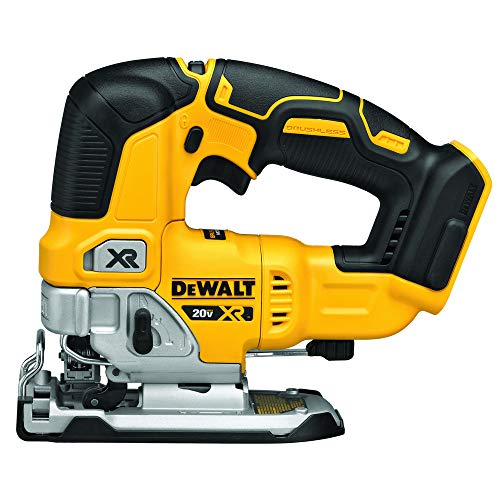
DEWALT 20V MAX Cordless Brushless Jig Saw
Best for: Users with existing DEWALT 20V batteries
- Voltage
- 20V MAX
- Power Source
- Cordless
- Dimensions
- 8.25 × 1.75 × 6.38 inches
- Weight
- 4.2 pounds
View on Amazon: DEWALT 20V MAX Cordless Brushless Jig Saw Affiliate link
This DEWALT DCS334B is a cordless jig saw powered by a 20V MAX brushless motor. It weighs 4.2 pounds and measures 8.25 inches long. The tool features variable speed control and a 4-position orbital action dial. An LED light illuminates your work surface. It suits users who need portable, precise cutting for various materials without cord constraints.
Pros
- Brushless motor delivers efficient performance and longer runtime
- Variable speed trigger and dial allow precise control
- 4-position orbital action adjusts cut quality and speed
- Integrated dust blower clears the line of sight
Cons
- Sold as a bare tool without battery or charger
- No battery included in the package
- Lacks a carrying case
Good fit if
- You need a compact tool for tight spaces
- You already own DEWALT 20V MAX batteries
- You require variable speed control for detailed work
Skip if
- You need a complete kit with battery and charger
- You prefer a corded tool for unlimited runtime
- You need a table saw for straight rip cuts
Verdict: DEWALT 20V MAX XR Brushless Jig Saw fits users who already have DEWALT 20V MAX batteries and need a lightweight, portable tool for detailed cutting tasks where cordless freedom matters.

Ryobi 7-Inch Portable Wet Tile Saw
Best for: Compact wet tile cutting tasks
- Blade Diameter
- 7"
- Dimensions
- 24.8 × 19.7 × 8.27 inches
View on Amazon: Ryobi 7-Inch Portable Wet Tile Saw Affiliate link
This is a 7-inch portable wet tile saw designed for cutting tile with water cooling. It features a stainless-steel table and a water reservoir system to manage dust and heat. The unit includes a miter guide for cuts up to 45 degrees and measures 24.8 inches in length. It suits users needing a dedicated tool for wet cutting tasks in a compact footprint.
Pros
- 7-inch blade diameter for tile cutting
- Stainless-steel corrosion-resistant table
- Water reservoir captures run-off
- Miter guide allows 0 to 45-degree cuts
Cons
- Limited to 7-inch blade capacity
- Requires water for operation
- Refurbished condition with 1-year warranty
Good fit if
- You need a dedicated wet cutting tool for tile
- You require a miter guide for angled cuts
- You want a stainless-steel table surface
Skip if
- You need to cut wood or metal
- You prefer a dry cutting method
- You require a blade larger than 7 inches
Verdict: Ryobi 7 in Portable Wet Tile Saw fits users who need a compact, water-cooled solution for tile work. Its stainless table and miter guide provide stability for angled cuts, making it a practical option for specific masonry tasks.
Specifications side by side
| Spec | DEWALT 20V MAX Cordless Brushless Jig Saw | Ryobi 7-Inch Portable Wet Tile Saw |
|---|---|---|
| Blade Diameter | not stated | 7" |
| Voltage | 20V MAX | not stated |
| Power Source | Cordless | not stated |
| Dimensions | 8.25 × 1.75 × 6.38 inches | 24.8 × 19.7 × 8.27 inches |
| Weight | 4.2 pounds | not stated |
| Size | One Size | not stated |
| Color | Yellow | Multicolor |
| Model | DCS334B | ZRWS722 |
Frequently asked questions
Are these DEWALT and RYOBI tools actually table saws?
No. The DEWALT item is a cordless jig saw. The RYOBI item is a portable wet tile saw. Neither is a table saw. You should look for different products if you need standard woodworking table saws. These tools serve specific niche tasks instead.
Can I use the DEWALT tool for cutting tiles?
No. The DEWALT DCS334B is a jig saw designed for detailed cuts in various materials. It does not have a water cooling system or a tile-specific blade. You should use the RYOBI wet tile saw for ceramic or porcelain tile work.
Does the RYOBI saw work without electricity?
No. The RYOBI ZRWS722 is a corded wet tile saw. It requires a power outlet to operate the blade and water pump. The DEWALT tool is battery-powered, but it is not suitable for tile cutting. Check your power source before buying.
Which tool is lighter to carry?
The DEWALT jig saw is lighter. It weighs 4.2 pounds. The RYOBI wet tile saw is much larger and heavier due to its table and water reservoir. If portability is your main concern, the DEWALT tool is the better choice for carrying.
What size blades do these tools use?
The RYOBI ZRWS722 uses a 7-inch blade for tile cutting. The DEWALT DCS334B is a jig saw and uses thin jig saw blades. They are not compatible with each other. You must buy blades specific to each tool type for safe operation.
Is the DEWALT tool part of a battery system?
Yes. The DEWALT DCS334B is a 20V MAX cordless tool. It works with existing DEWALT 20V MAX batteries. This is helpful if you already own other DEWALT cordless tools. The RYOBI saw is corded and does not use batteries.
Does the RYOBI saw have a water tank?
Yes. The RYOBI ZRWS722 is a wet tile saw. It includes a water reservoir to cool the blade and reduce dust. This feature is essential for cutting ceramic and porcelain. The DEWALT jig saw does not have this cooling system.