20V MAX vs 18V Table Saws in 2026: Key Differences
As an Amazon Associate we earn from qualifying purchases. Links on this page are affiliate links.
You are comparing a 20V MAX jigsaw against an 18V X2 circular saw. This 20V MAX vs 18V table saw guide focuses on their core specifications. Both tools use brushless motors for efficiency. The main difference lies in their power source and intended cut type. The DEWALT model runs on a single 20V battery. The Makita model uses two 18V batteries for higher voltage. You need to understand these specs to pick the right tool.
Key differences
| Aspect | DEWALT 20V MAX Cordless Brushless Jig Saw | Makita 18V X2 Brushless 7-1/4-Inch Rear Handle Saw |
|---|---|---|
| Voltage | 20V MAX | 18V (uses 2 batteries for 36V X2) |
| Motor Type | Brushless | Brushless |
| No-Load Speed | 3,200 Blade Speed | 5,100 RPM |
| Weight | 4.2 pounds | 12.1 pounds |
Which one should you choose?
Choose DEWALT 20V MAX Cordless Brushless Jig Saw if
- You need a lightweight tool for detailed, curved cuts.
- You prefer using a single battery from your existing 20V MAX system.
- You want a compact tool that fits in tight spaces.
Choose Makita 18V X2 Brushless 7-1/4-Inch Rear Handle Saw if
- You require more power for cutting thick lumber.
- You already own two 18V LXT batteries.
- You need a larger blade for deeper cutting capacity.
Verdict: The DEWALT jigsaw is the better choice for precision work and portability. The Makita circular saw offers more raw power for ripping through thick materials. Choose the DEWALT for detail work and the Makita for structural cuts.
Voltage and Power Source Differences
Voltage System
Product A uses a standard 20V MAX battery system. Product B utilizes 18V X2 technology, which combines two 18V batteries to create a 36V power source. This dual-battery setup in Product B allows for higher output compared to the single 20V pack in Product A. You get more raw power from the Makita configuration, which helps with demanding cuts. The DEWALT tool relies on its brushless motor efficiency to maximize runtime from its single battery. Your choice depends on whether you prefer the simplicity of one battery or the extra torque from two.
Motor Type
Both tools feature brushless motors, which is a significant advantage for modern cordless power tools. Product A highlights its brushless motor for efficient performance and longer runtime compared to older brushed models. Product B also uses an electronically controlled brushless motor, noting that it eliminates carbon brushes to run cooler and more efficiently. This design choice in both products extends motor life and improves overall reliability. You benefit from reduced maintenance and consistent power delivery in either case. Neither tool lists a brushed motor option, so you get the same core efficiency technology in both.
Cutting Capacity
Product B offers a substantial 2-9/16 inch cutting capacity at 90 degrees, allowing it to cut through 3-inch material in a single pass. This makes it suitable for thicker lumber and structural work. Product A is a jig saw, so its cutting depth is not specified in the provided data, but jig saws generally handle thinner materials or intricate curves rather than deep cross-cuts. The Makita circular saw clearly wins for deep, straight cuts in thick wood. If you need to rip through heavy timber, Product B is the superior choice due to its large blade and depth capability.
Weight and Portability
Product A weighs 4.2 pounds, making it very lightweight and easy to handle for extended periods. Product B weighs 12.1 pounds, which is significantly heavier due to its larger motor and battery configuration. The lighter DEWALT jigsaw is easier to maneuver for detailed work and overhead cuts. The heavier Makita circular saw provides more stability during heavy cutting but may cause fatigue during prolonged use. You should consider your physical comfort and the type of cuts you perform most often when weighing this difference.
Speed and Control
Product B reaches a no-load speed of 5,100 RPM, providing fast cutting performance for circular saw operations. It also features Automatic Speed Change technology to adjust torque and speed during the cut. Product A offers variable speed control via a trigger and dial, allowing you to adjust the blade speed for different materials. While Product B has a fixed high-speed ceiling, Product A gives you manual control over the speed. For precision work on delicate materials, the adjustable dial on Product A is advantageous. For speed in softwoods, Product B is faster.
Choose the right saw for your needs
Need precise curve cutting and portability
The DEWALT DC334B is a compact jigsaw weighing only 4.2 pounds. Its 20V MAX brushless motor provides efficient performance for detailed work. The variable speed trigger and dial allow you to control cut quality precisely. The integrated dust blower clears your line of sight, while the LED light illuminates dim work surfaces for accuracy.
Require high power for thick lumber
The Makita XSR01Z uses two 18V batteries to create a powerful 36V system. Its brushless motor delivers 5,100 RPM for maximum performance. This setup allows up to 558 cross-cuts in 2x4 SPF lumber on a single charge. The large 2-9/16 inch cutting capacity at 90 degrees lets you cut through thick material in a single pass.
Want versatile bevel adjustments for angles
The Makita saw offers a 0 to 53 degree bevel capacity with positive stops at 22.5, 45, and 53 degrees. This range exceeds the DEWALT jigsaw's 45-degree limit. The automatic speed change technology adjusts torque during cuts for optimum performance. The electric brake stops the blade quickly, enhancing safety and productivity during angled operations.
Quick picks
| # | Product | Best for | Price |
|---|---|---|---|
| 1 | DEWALT 20V MAX Cordless Brushless Jig Saw | Users needing precise control and compact handling | Check price of DEWALT 20V MAX Cordless Brushless Jig Saw on Amazon |
| 2 | Makita 18V X2 Brushless 7-1/4-Inch Rear Handle Saw | Makita users needing cordless power | Check price of Makita 18V X2 Brushless 7-1/4-Inch Rear Handle Saw on Amazon |
The products compared
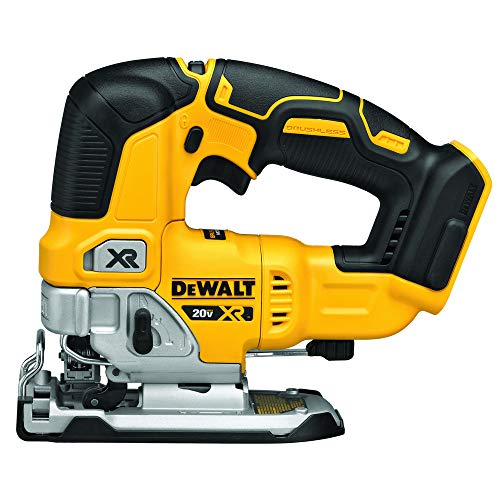
DEWALT 20V MAX Cordless Brushless Jig Saw
Best for: Users needing precise control and compact handling
- Voltage
- 20V MAX (what this guide is about)
- Power Source
- Cordless
- Dimensions
- 8.25 × 1.75 × 6.38 inches
- Weight
- 4.2 pounds
View on Amazon: DEWALT 20V MAX Cordless Brushless Jig Saw Affiliate link
The DEWALT 20V MAX XR Jig Saw (DCS334B) is a cordless tool weighing 4.2 pounds with a 20V MAX battery system. It features a brushless motor for efficient performance and a 3,200 blade speed. The unit includes a 4-position orbital action dial and an all-metal keyless shoe for bevel adjustments up to 45 degrees. It suits users needing precise control in a compact, yellow-bodied design.
Pros
- Brushless motor delivers efficient performance and longer runtime
- Variable speed trigger and dial provide precise control
- 4-position orbital action adjusts cut quality and speed
- All-metal keyless shoe bevels at 0, 15, 30, and 45 degrees
Cons
- Bare tool only requires separate battery purchase
- Limited to 20V MAX power source
- No integrated dust collection port listed
Good fit if
- You need a compact tool for maximum control
- You require precise speed and orbital adjustments
- You already own 20V MAX batteries
Skip if
- You need a corded power source
- You require a 36V or higher voltage system
- You prefer a tool with integrated dust collection
Verdict: DEWALT 20V MAX XR Jig Saw offers precise control and efficient runtime for users who already own 20V MAX batteries. It fits those needing compact handling and adjustable orbital settings for detailed cuts.

Makita 18V X2 Brushless 7-1/4-Inch Rear Handle Saw
Best for: Makita users needing cordless power
- Voltage
- 18V (what this guide is about)
- Blade Diameter
- 7-1/4"
- No-Load Speed
- 5,100 RPM
- Cutting Depth 90
- 2-9/16”
- Dimensions
- 18.8 × 8.9 × 12 inches
- Weight
- 12.1 pounds
View on Amazon: Makita 18V X2 Brushless 7-1/4-Inch Rear Handle Saw Affiliate link
This Makita tool uses two 18V batteries to create a 36V system. It features a brushless motor that runs at 5,100 RPM. The blade diameter is 7-1/4 inches with a cutting depth of 2-9/16 inches at 90 degrees. You get automatic speed change technology and an electric brake. It weighs 12.1 pounds. This setup suits users who need cordless power comparable to corded models for framing or general construction.
Pros
- 36V output from two 18V LXT batteries
- Brushless motor delivers 5,100 RPM
- 2-9/16 inch cutting capacity at 90 degrees
- Automatic speed change technology for optimum performance
Cons
- Requires two batteries instead of one
- Tool only; batteries and charger not included
- Heavier at 12.1 pounds than single-battery 18V models
Good fit if
- You already own Makita 18V LXT batteries
- You need higher power than standard 18V tools
- You want brushless motor efficiency
Skip if
- You prefer a single-battery system
- You need a compact tool under 10 pounds
- You want a complete kit with batteries included
Verdict: Makita XSR01Z 36V Brushless Circular Saw delivers 36V power to users who already have Makita 18V batteries. It is ideal for those who need extra torque and run time without a cord.
Specifications side by side
| Spec | DEWALT 20V MAX Cordless Brushless Jig Saw | Makita 18V X2 Brushless 7-1/4-Inch Rear Handle Saw |
|---|---|---|
| Blade Diameter | not stated | 7-1/4" |
| No-Load Speed | not stated | 5,100 RPM |
| Cutting Depth 90 | not stated | 2-9/16” |
| Voltage | 20V MAX | 36V (18V X2) |
| Power Source | Cordless | not stated |
| Dimensions | 8.25 × 1.75 × 6.38 inches | 18.8 × 8.9 × 12 inches |
| Weight | 4.2 pounds | 12.1 pounds |
| Size | One Size | No Size |
| Color | Yellow | Teal |
| Model | DCS334B | XSR01Z |
Frequently asked questions
Is 20V MAX better than 18V for table saws?
The voltage rating alone does not determine the best tool for your needs. You must look at the specific motor type and intended use. For example, a 20V MAX jigsaw offers precise control in a compact form. An 18V system can combine two batteries for higher power. Choose based on whether you need detailed cuts or heavy-duty ripping.
What is the difference between 20V and 18V X2?
A standard 20V system runs on a single battery pack. An 18V X2 system links two 18V batteries to create 36V of power. This dual-battery setup provides more torque and runtime than a single 20V pack. The DEWALT model uses one 20V MAX battery. The Makita model uses two 18V batteries for increased output.
Does a brushless motor matter in cordless saws?
Yes, brushless motors are more efficient and durable than brushed ones. They generate less heat and require less maintenance. Both the DEWALT and Makita tools in this comparison use brushless technology. This means you get longer runtime and consistent power delivery. It is a standard feature for modern professional-grade cordless power tools.
How heavy are cordless table saws compared to corded?
Cordless tools vary in weight based on their design and battery integration. The DEWALT 20V MAX jigsaw weighs 4.2 pounds without a battery. The Makita 18V X2 circular saw weighs 12.1 pounds. These weights affect portability and ease of use. Heavier tools may offer more stability but are less convenient to carry around a job site.
Can I use 20V batteries in an 18V tool?
No, battery systems are generally not cross-compatible between brands. You must use the specific battery platform for each tool. The DEWALT tool requires 20V MAX batteries. The Makita tool requires 18V LXT batteries. If you already own batteries for one brand, stick with that ecosystem to save money and reduce clutter.
What is the best saw for precise cuts?
If you need precise curve cutting, a jigsaw is the right choice. The DEWALT DC334B is designed for detailed work with adjustable orbital settings. It weighs only 4.2 pounds for easy handling. For straight cuts, a circular saw like the Makita XSR01Z is better. It delivers 36V power for clean, straight lines in thicker materials.
Do I need a special blade for these saws?
Each tool uses blades designed for its specific cutting action. The Makita circular saw accepts 7-1/4-inch blades for straight cuts. The DEWALT jigsaw uses thin, reciprocating blades for curves and intricate shapes. Always match the blade type to the tool. Using the wrong blade can damage the saw or result in unsafe cutting conditions.